Immigration politics in Scotland after the election
Prof Sergi Pardos-Prado
Professor of Comparative Politics at the University of Glasgow. He is also a member of the Migration Advisory Committee, which gives independent and evidence-based advice to the UK Government on immigration policy. Previously he was Associate Professor in Politics at Merton College, University of Oxford.
Scotland seemed surprisingly immune to the turbulence of immigration debates and populist upheaval that have shaken Western liberal democracies over the past decade. The 2026 Scottish Parliament election, however, brought this rare European exception to an end. Reform UK’s breakthrough, winning 17 MSPs and nearly 17% of the vote in the regional ballot, marks a decisive turning point, closing a chapter defined by a markedly pro-immigration stance across the political spectrum that endured through successive political and economic crises.
What does the end of Scottish exceptionalism mean for immigration? As is always the case with this topic, it is important to distinguish between policy and politics. The main conclusion to draw from the 2026 election is that its impact on immigration policy will be minimal. Its impact on immigration politics, however, is likely to be considerably more substantial.
Starting with the policy side. Immigration is a reserved matter: only the Westminster government has the power to set the rules. Nothing in the arguments of the 2026 campaign shed light on how to overcome the practical constraints of implementing a more liberal, distinctively Scottish approach to immigration. And nothing in the electoral results suggests any change in the perennial deadlock between a pro-devolution Scottish government and a UK government staunchly opposed to devolve policy levers.
Several factors support this conclusion and some are structural. Immigration policy is rarely decentralised among OECD countries, partly because doing so risks disrupting labour markets where identical occupations carry different salary thresholds or requirements across jurisdictions. The case for devolution has yet to grapple seriously with the potential costs and inefficiencies for Scottish firms that operate across the UK, and that would have to navigate two separate immigration systems simultaneously.
If the 2026 election is unlikely to bring major shifts in immigration policy, what about the politics of immigration? That is a different question. Since attitudinal change in public opinion tends to be slow, Reform UK’s breakthrough suggests that the long absence of radical right politics in Scotland was more a matter of supply than demand. There have been signs for some time that the pro-immigration consensus in Scottish public opinion was somewhat overstated, conditional on the type of migration in question, and far from immune to localised backlash against asylum seekers.
What are the likely consequences of a prominent anti-immigration voice in the Scottish Parliament? Two scenarios are worth considering, though one is considerably more plausible than the other. The first would be a broad shift towards immigration-sceptic narratives across the political spectrum. A discursive race to chase back voters lost to populist entrepreneurs, much as Labour under Keir Starmer and many mainstream parties across Europe have attempted, typically unsuccessfully.
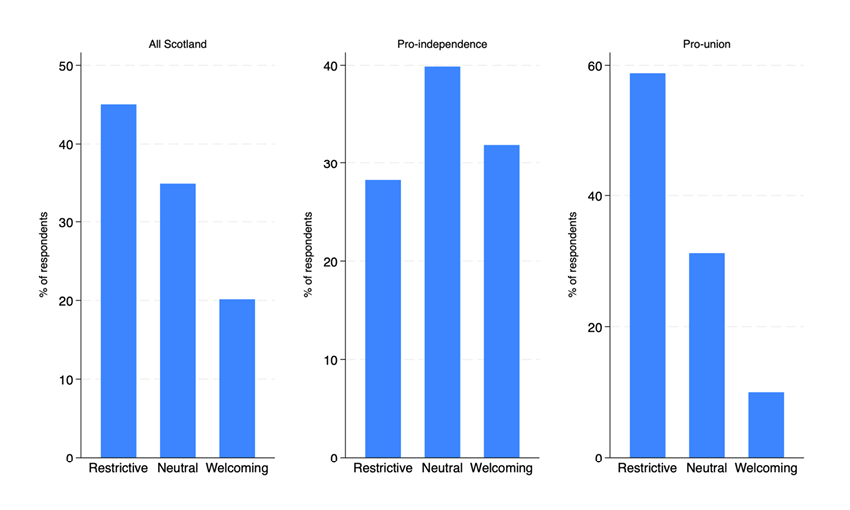
The second scenario would be an entrenchment and deepening polarisation of positions on immigration, particularly between a broadly pro-immigration and pro-independence camp, versus a more immigration-sceptic unionist camp. Recent Scottish public opinion data before the election points strongly towards this second scenario.
When asked about the ideal number of immigrants permitted to come to Scotland, Figure 1 shows a plurality of respondents holding restrictive views (number should decrease by a lot or a little). This confirms that the potential to mobilise immigration scepticism, especially when the issue is framed in terms of inflows, is higher than commonly assumed. Crucially, however, this restrictive outlook is not evenly distributed across the electorate. Among respondents who would vote Yes in a future independence referendum, over 70% hold neutral or welcoming views on immigration. There is a real potential for splits within the independence camp (close to 30% of Yes voters favour reducing immigration) but this figure is modest compared to the unionist side, where nearly 60% of respondents hold restrictive views on border control.
The divide becomes even starker when respondents are asked to assess the economic and cultural impacts of immigration. Fewer than 20% of pro-independence voters hold negative views on immigration’s economic effects, while the figure rises to nearly 40% among unionists. A similar gap emerges on cultural impact. Further analysis of Scottish Opinion Monitor data from earlier in the decade suggests these differences have remained stable over time, pointing to a durable cleavage rather than a reaction to recent events.
The potential for division within the independence camp is real, particularly when immigration is framed in terms of inflows and border control (less so when the focus shifts to economic and cultural impacts). But the broader picture is clear: restrictive views on immigration are concentrated overwhelmingly among unionists, the gap between constitutional camps has shown no signs of narrowing over time, and there is little evidence that Reform UK has drawn significant numbers of voters away from pro-independence parties. Taken together, this suggests that a minority SNP government has limited incentives to embrace restrictive positions, and that doubling down on a welcoming Scottish identity carries relatively little electoral risk.
Reform UK’s arrival in Parliament suggests that immigration is likely to become a more salient, entrenched and polarised issue in Scottish politics, deepening the constitutional divides that have defined the last decade, rather than cutting across them in new ways.
Figure 1: Public views on ideal number of immigrants permitted to live in Scotland.
Source: Scottish Opinion Monitor from February 2026