Prof Stefanie Reher
Professor of Political Science at the University of Strathclyde. Her research examines the participation, experiences, and representation of disabled people in politics, as well as public opinion about diversity in policymaking. She is the author, with Elizabeth Evans, of Disability and Political Representation (Oxford University Press).
Scottish Election 2026
Section 4: Democracy and representation
- Looking beyond numbers: Gender sensitivity in the new parliament (Prof Meryl Kenny, Prof Sarah Childs)
- Disability representation in the Scottish Parliament: Gains, gaps, and promises (Prof Stefanie Reher)
- More progress without parity? Ethnic minority representation at Holyrood after 2026 (Prof Nasar Meer FBA, Dr Timothy Peace)
- Who represents Scotland? Class and gender of Holyrood in 2026 (Shevaun Smith)
- Questions of representation: How diverse are our MSPs (Dr Lynn Bennie)
- Over the rainbow? What next for Scotland’s new “Rainbow Parliament”? (Prof Christopher Carman)
Advocating for disability rights and interests in Parliament is of course by no means the exclusive domain of disabled representatives. Yet, in practice it is frequently politicians who belong to a particular group who speak out on behalf of that group, often drawing on their own lived experience. Whether members of a marginalised group have a seat at the table can also send a powerful signal about the group’s role in society. Therefore, given the significant inequalities and exclusion that the disability community continues to face, the question of political representation is particularly important for them.
Disabled people are underrepresented amongst politicians globally, but what about the new Scottish Parliament? It is difficult to get accurate data, as many disabilities are invisible and some politicians might be hesitant to disclose them, for instance because they prefer to focus on other political issues or because of the negative stigma that continues to exist in society. Although recent research suggests that public attitudes towards disabled politicians are often rather positive, in reality they face a substantive risk of harassment and (online) abuse. Some disabled politicians have also reported negative reactions from within their parties, with some being questioned about whether they would be “up to the job”. Keeping this caveat in mind, it appears that at least 9 disabled candidates were elected on 7th May, all of them representing the SNP or Scottish Greens (based on figures from Inclusion Scotland and politicians who have publicly identified as disabled). Accounting for 7% of MSPs, this number is far lower than the 24.1% of Scots who report a long-term health condition or disability. Still, it is a significant increase from the estimated 5 disabled MSPs in the last Parliament, and certainly higher than the estimated 2% in the House of Commons. One of the newly elected MSPs is Kayleigh Kinross-O’Neill, who uses a wheelchair and draws on her experience as a local councillor and disability activist.
A key policy aimed to improve disability representation in Scotland is the pioneering Access to Elected Office Fund, which covers the additional costs that disabled candidates face campaigning. According to Inclusion Scotland, who have administered the Fund since 2016, 21 candidates made use of it in this election, up from 14 in 2021. Five of these candidates got elected, a record number. The main expenses the Fund covered to make the election campaign a more level playing field were for personal assistants, travel, coaching, and assistive technology.
Besides the number of disabled MSPs, the parties’ manifestos also give us an indication of what disability policy in Scotland might look like over the next years. A first clue about how much the parties care about representing the disability community is the accessibility of their manifestos. Ideally, all parties would publish their manifestos in audio, Braille, British Sign Language (BSL), Easy Read, and large or clear print. Only the SNP published their manifesto in all these formats, while the Liberal Democrats, Labour, and Greens each provided three of them (none in BSL). The Conservatives and Reform UK supplied no accessible manifestos.
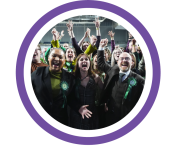
And what have the parties promised to do for disabled people over the next parliamentary term? The diversity of attention to disability across the manifestos is striking. While the Greens have dedicated “Disabled People” and “Mental Health and Neurodivergence” sections, Reform UK’s manifesto does not include any specific pledges to disabled people. Table 1 summarises which issues each party’s manifesto addresses. Similarly to manifesto accessibility, the number of disability-related pledges differs significantly along the ideological spectrum. While the SNP provided the most accessible manifestos, the Greens set out the most comprehensive agenda on how to improve the lives of disabled Scots. The coming months and years will show to what extent these pledges will be fulfilled, and whether the new cohort of disabled, and disability activist, MSPs will be driving this agenda.