Prof Christopher Carman
Stevenson Professor of Citizenship at the University of Glasgow. He has been one of the lead researchers on the Scottish Election Study since 2011 and has written several books and articles on Scottish voting, public opinion and elections. His most recent research examines preferences for compromise in politics.
Scottish Election 2026
Section 4: Democracy and representation
- Looking beyond numbers: Gender sensitivity in the new parliament (Prof Meryl Kenny, Prof Sarah Childs)
- Disability representation in the Scottish Parliament: Gains, gaps, and promises (Prof Stefanie Reher)
- More progress without parity? Ethnic minority representation at Holyrood after 2026 (Prof Nasar Meer FBA, Dr Timothy Peace)
- Who represents Scotland? Class and gender of Holyrood in 2026 (Shevaun Smith)
- Questions of representation: How diverse are our MSPs (Dr Lynn Bennie)
- Over the rainbow? What next for Scotland’s new “Rainbow Parliament”? (Prof Christopher Carman)
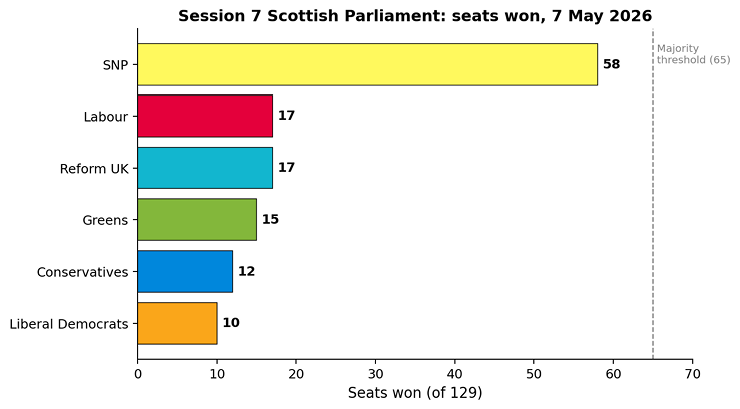
The Scottish Parliament election on the 7th of May produced a remarkable result. The SNP returned as the largest party with 58 seats, but well short of a majority, while Labour and Reform UK tied as joint second on 17 each. The Greens took 15, the Conservatives 12, and the Liberal Democrats 10 (Figure 1) — so six parties, all with ten or more members. Remarkably, 64 of the 129 MSPs are entirely new, and many have little experience of elected office. The pro-independence side holds a slim 73-seat majority, but no government can be formed and almost no business completed without cross-party negotiation.
“Politics”, Gerry Stoker observed in Why Politics Matters “is about reaching a compromise and finding ways for those who disagree to rub along with one another.” While not identical to the 2003 rainbow parliament, the label nonetheless captures the spirit of Session 7 and the new Parliament. Power is dispersed; a tied-second party is unique in Holyrood’s history; and 64 newcomers must learn to rub along with peers and political opponents alike. Whether the new Parliament “works” — whether it can deliver legislation and credible scrutiny — depends on whether MSPs, the rules they sit under, and the public they answer to can lean into compromise.
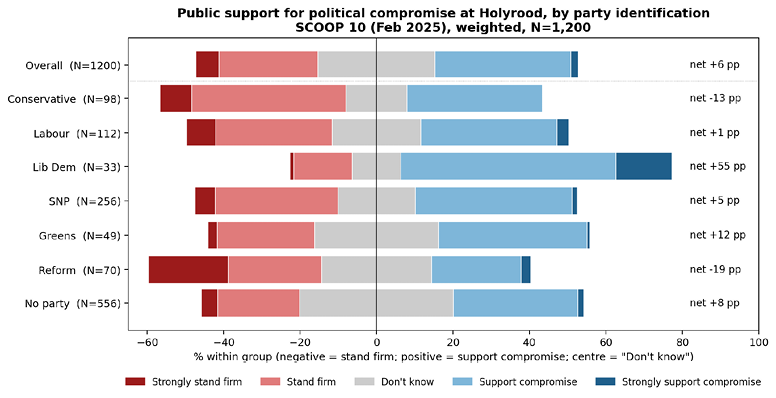
The most direct survey measure of the Scottish public’s appetite for cross-party working is the dedicated compromise item in the Scottish Election Study’s SCOOP 10, which asked whether “the politicians at Holyrood who share your beliefs” should compromise with the other side or stand firm on principle. The headline finding is striking: 30.6% of respondents said they did not know. Among those who took a view (N=871), 54% supported compromise and 46% stood firm — a soft, narrow compromising plurality, not a consensus (Figure 2). However, that aggregate hides a sharp partisan cleavage. Net support for compromise runs from +55 percentage points among Liberal Democrat identifiers and +12 pp among Greens to −13 pp among Conservatives and −19 pp among Reform identifiers. SNP identifiers, the largest party group, split almost evenly (+5 pp), as do Labour identifiers (+1 pp). MSPs face genuine cross-pressure: a manifesto mandate to deliver, and a partisan electorate that will pressure them case by case and along party lines.
With six parties of ten-plus MSPs and a tied-second, several conventions that worked when there was a clear pecking order need re-engineering before the chamber meets. Holyrood’s rules do not formally recognise an “Official Opposition”; the term is conventional, attached to the largest non-government party. With Labour and Reform tied, even that convention dissolves. Standing Orders Chapter 13 entitles the leader of any party with five or more MSPs to be called at First Minister’s Questions, and convention has the largest opposition leader called first with multiple substantive exchanges. The Welsh Senedd offers a model: the Llywydd used a weekly rotation between tied leaders to lead the First Minister Questions slot.
The same logic radiates out from FMQs. The Bureau (Chapter 5) consists of the Presiding Officer plus a business manager from each party with five or more seats: all six parties qualify. Its proportional allocations of opposition business days, committee membership and the new elected-convener regime must split symmetrically between Labour and Reform. The four elected places on the Scottish Parliamentary Corporate Body (SPCB), and the more mundane but politically charged question of office allocation in Members’ Block and seating in the chamber, require the same negotiated balance.
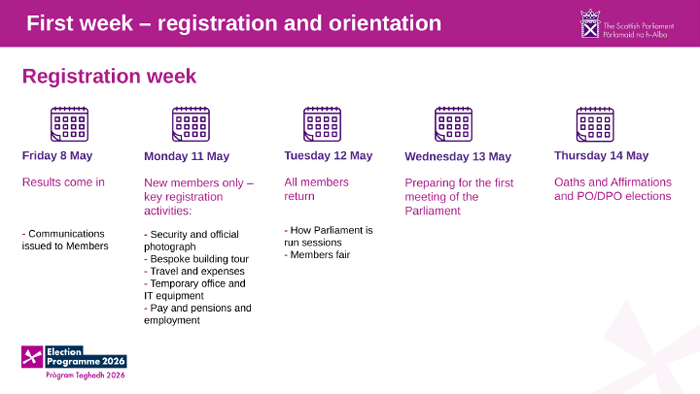
The harder task is human. With 64 new Members — Holyrood’s largest intake — the Parliament is absorbing many Members who have never held elected office and who fundamentally disagree with peers across the aisle. Allan Campbell, Head of Operations, set out the Parliament’s innovative 2026 Election Programme at a Stevenson Trust lecture in March: it includes a set of information sessions, induction events and a buddy programme. Pre-election work included SPCB guidance to sitting Members and structured political engagement to secure cross-party buy-in. From the 11th of May – less than a week after the election – registration activities for new Members began (Figure 3). Crucially, cross-party relationship-building is woven through evening receptions and the Members’ Fair on the 12th of May — all to develop social capital and facilitate Stoker’s “rubbing along”.
Rubbing along requires both a public willing to live with compromise and an institution capable of producing it. Both conditions are partial in 2026. The public are softly, conditionally pro-compromise, with sharp partisan exceptions. The standing orders must be stretched to handle a tied-second party and six party business managers; and committee allocations, opposition days and the SPCB must all be split fairly. Above all, 64 new MSPs must learn the chamber and learn each other — including those they were elected to oppose. If those three pieces — public tolerance, procedural fairness, and informal relationship-building — fall into place, this could be a Parliament that compromises productively to deliver policy and scrutiny. If those fail, it risks reproducing the fractiousness reported in the closing months of the last parliament — and a “Rainbow Parliament” that doesn’t quite work.