Dr Camila Mont’Alverne
Lecturer in Journalism, Media, and Communication at the University of Strathclyde and a Research Associate to the Reuters Institute for the Study of Journalism, University of Oxford.

Scottish Election 2026
Section 2: News, media and journalism
- News consumption in Scotland (Dr Camila Montalverne)
- TikTok’s For You Page recommendations during the Scottish Parliament election (Dr Dayei Oh, Dr Chamil Rathnayake)
- From participation to consumption? Youth engagement and “parasocial media” (Dr James Dennis)
- The battle for trust in the Holyrood election (Prof Catherine Happer, Dr James Morrison, Dr Lluis de Nadal)
- Polls over policy in UK-wide TV news coverage of Elections (Dr Maxwell Modell, Dr Keighley Perkins, Prof Stephen Cushion)
- Legacy news coverage of the election – Leaders debate and press coverage (Dr Steven Harkins)
- All right, own up, who let the woman in? (Dr Fiona McKay, Dr Melody House)
- Negotiations of the constitutional question (Dr Maike Dinger)
The 6th Scottish Parliament session (2021-2026) unfolded during a period of significant shifts in people’s relationships with news organisations and digital platforms. These years included acute phases of the COVID-19 pandemic and its aftermath, widespread concerns about the cost of living, political instability both in Holyrood and Westminster, and a UK General Election. All of this occurred against a backdrop of increasing reliance on digital platforms for gathering information, challenges to trust in traditional sources of news, and concerns about misinformation in many parts of the world. Drawing on survey data of Scottish audiences from the Digital News Report (DNR), produced by the Reuters Institute for the Study of Journalism at the University of Oxford, this chapter examines patterns and changes in news consumption habits in Scotland from 2021 to 2025. The DNR is fielded online in more than 40 countries, in January and February each year.
Frequency of news consumption remained broadly stable during the last Parliament session, but with signs of decline in 2025. In 2021, 75% of the Scottish sample reported that they accessed news – defined as national, international, regional/local news and other topical events accessed via any platform (radio, TV, newspaper or online) – once a day or more. This proportion rose slightly through 2022 (76%), 2023 (78%), and 2024 (81%) before falling to 69% in 2025. At the other end of the spectrum, those who said they consumed news less often than once a month or never increased from 8% in 2021 to 13% in 2025, indicating an increase in consistent news avoidance – individuals with low or no levels of news consumption, regardless of their intention – in the nation. Although still a minority, this group was larger in 2025 than those who reported using printed sources (11%).
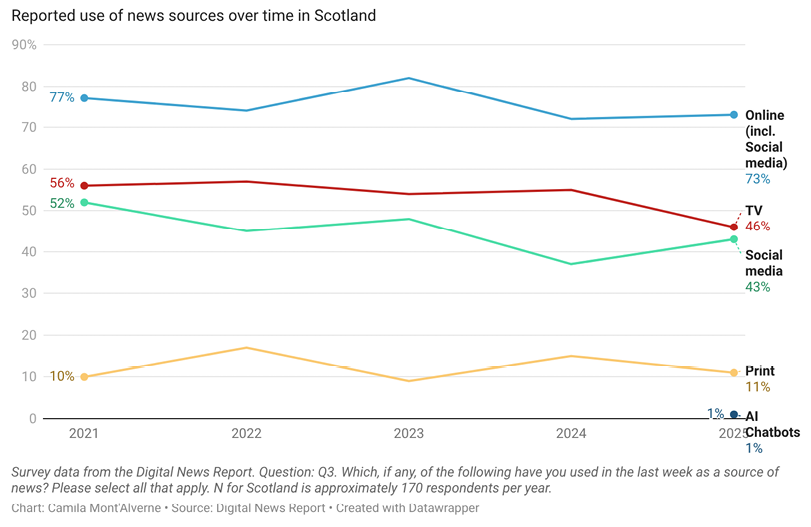
When Scottish participants were asked about their sources of news in the previous week to the survey, online sources dominated throughout the period. Use of any online source (including news websites and social media) remained relatively stable: 77% reported using them in 2021 and 73% in 2025. There is a slight dip in 2022 (74%) before a peak at 82% in 2023.
Looking more closely at different types of online sources reveals further nuance. There is a slight decline in access to online sources when excluding social media: 62% in 2021 said they used sources such as news websites in the previous week and 57% in 2025. When it comes to social media, 52% of Scottish interviewees declared using it for news in 2021, compared to 43% in 2025. Social media use for news seems to peak in relevance in 2023, when 25% of participants said it was their main source of news – the same proportion who named TV in the same year. In 2025, respondents were asked for the first time about generative AI, and 1% in Scotland reported using AI chatbots as a source of news in the previous week.
Despite its downward trend, TV remained one of the most used sources of news in Scotland, with 56% of participants reporting using it in 2021 and 46% in 2025 – almost the same proportion as those who reported to use social media for news. These patterns paint a nuanced picture of news consumption in Scotland: online sources are consistently dominant, social media is a relevant source, and traditional news organisations continue to reach substantial segments of the Scottish audience.
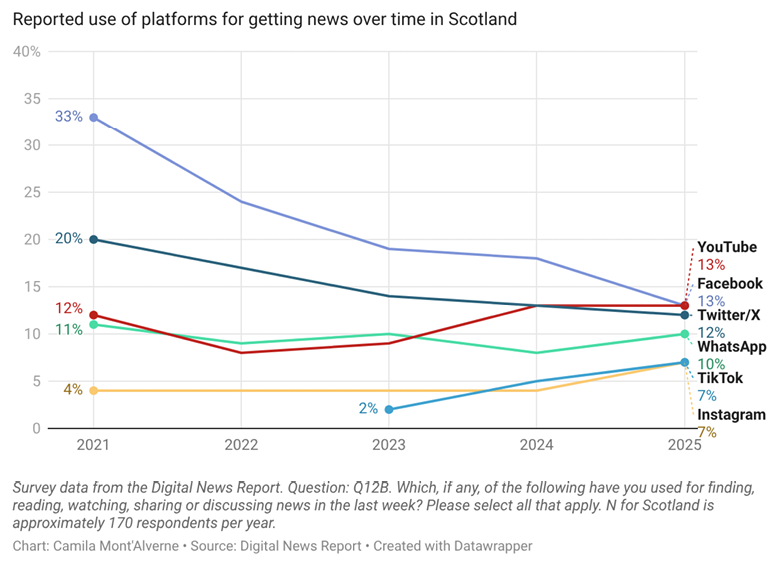
Examining specific platforms shows a landscape of increasing fragmentation. Facebook remained the most used platform for news, but by 2025 it shared this position with YouTube. In 2021, 33% of Scottish interviewees reported using the Meta-owned platform for finding, reading, watching, sharing, or discussing news in the previous week. This proportion declined steadily, reaching 13% in 2025. Twitter (now X), the second most used platform for news in 2021 (20%), followed a similar trajectory, falling to 12% in 2025.
The decline of Facebook and X was not accompanied by the emergence of a new dominant platform. Instead, Scots’ use of social platforms for news became more fragmented, with modest increases in video-based platforms. In 2025, 13% of participants reported using YouTube for news, 10% used WhatsApp, and 7% used Instagram. TikTok use for news also rose consistently: first recorded at 2% in 2023, rising to 7% in 2025.
Overall, the last Parliament session was marked by consolidation of online sources as the main channels through which people in Scotland access news, even as TV remained relevant. Social media use for news became increasingly fragmented, which may pose challenges for news organisations and public institutions seeking to communicate with diverse audiences. Yet social media platforms still account for a smaller share of people’s media diets in Scotland than in many other parts of the world. The strength of a reliable public service media landscape (an exception when compared to most countries) helps to anchor the news environment, offering some protection against the erosion of the role of traditional sources. Even so, the long term effects of increasing platform reliance and the arrival of generative AI on Scots’ news habits remain to be seen.