
Dr Maxwell Modell
Research Associate at Cardiff University and part of the Enhancing the Impartiality of Political News project. His research focuses on the interplay between journalism and politics, with a particular emphasis on how news media is reimagining itself in response to digital technologies such as podcasts.

Dr Keighley Perkins
Research Associate at Cardiff University and part of the Enhancing the Impartiality of Political News project. Her work focuses on political communication, media impartiality and digital discourse, particularly the relationship between language, politics and digital media.

Prof Stephen Cushion
Professor at the Cardiff School of Journalism, Media and Culture at Cardiff University. He is currently leading the Enhancing the Impartiality of Political News project.

Scottish Election 2026
Section 2: News, media and journalism
- News consumption in Scotland (Dr Camila Montalverne)
- TikTok’s For You Page recommendations during the Scottish Parliament election (Dr Dayei Oh, Dr Chamil Rathnayake)
- From participation to consumption? Youth engagement and “parasocial media” (Dr James Dennis)
- The battle for trust in the Holyrood election (Prof Catherine Happer, Dr James Morrison, Dr Lluis de Nadal)
- Polls over policy in UK-wide TV news coverage of Elections (Dr Maxwell Modell, Dr Keighley Perkins, Prof Stephen Cushion)
- Legacy news coverage of the election – Leaders debate and press coverage (Dr Steven Harkins)
- All right, own up, who let the woman in? (Dr Fiona McKay, Dr Melody House)
- Negotiations of the constitutional question (Dr Maike Dinger)
UK-wide TV news coverage of the national elections in Scotland and Wales, and local elections in England was limited and treated as second-order contests. When they were reported, coverage often framed the elections as a horse race rather than focusing on substantive policy analysis or scrutiny.
We analysed three flagship UK network news bulletins – BBC News at Ten, ITV News at Ten and Channel 4 News (at 7pm) – tracking how often and in what ways the elections were reported between 2nd March (the date the first party manifesto was launched) and 6th May (the final day of campaigning). This matters because in both Scotland and Wales more voters watch UK-wide news than national bulletins.
These elections posed a unique challenge for broadcasters, who had to juggle three separate contests and 17 parties or national party variants – all within special election guidelines requiring roughly equal coverage of all major parties, in line with their recent election performance and consistent trends in public opinion polls.
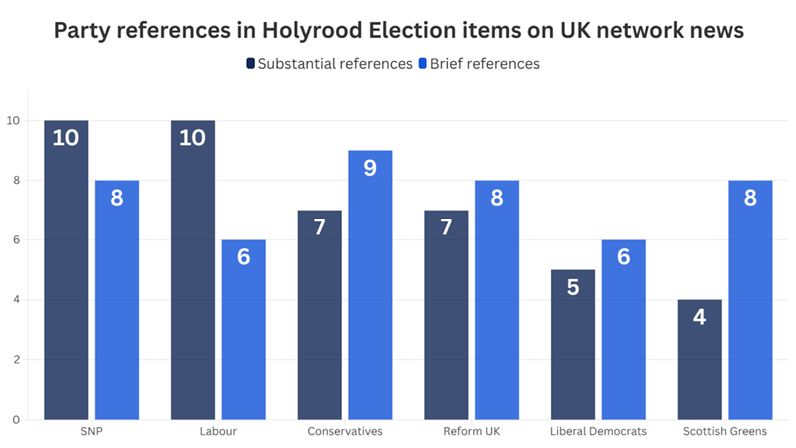
This is something the broadcasters broadly achieved in all three elections. In Scottish election coverage, the SNP and Labour led with 10 substantial references each, seeming to benefit from an incumbency boost as the current governing party in Scotland and the UK. The Conservatives and Reform UK received 7 substantial references each, compared to 5 for the Liberal Democrats and 4 for the Scottish Greens. See Figure 1.
Across all broadcasters there was a highly structured, formulaic approach focused on predictable campaign events, such as manifesto launches, broadcast leaders’ debates and the latest polls.
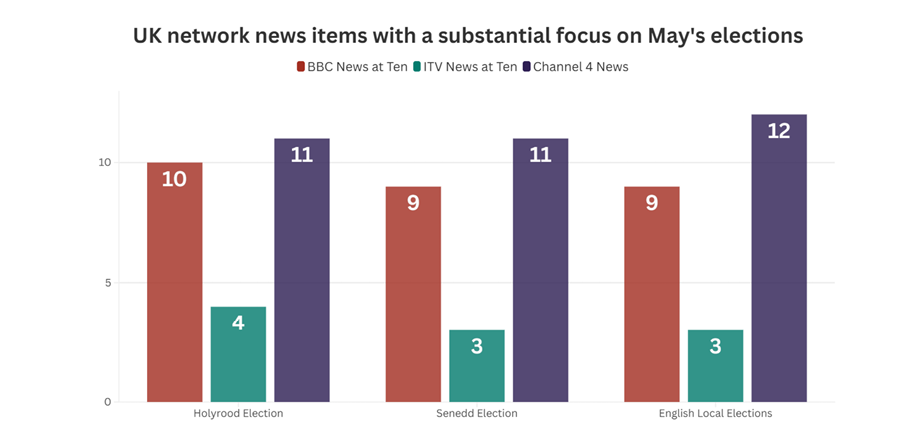
The Holyrood election, the Senedd election, and the English local elections received a similar amount of coverage. See Figure 2.
Channel 4 provided the most substantial coverage in both frequency and depth, including replacing its regular bulletin with a Scottish and Welsh leaders’ debate on 14th April and 21st April, respectively.
ITV News at Ten provided the least coverage, with the bulk of this being concentrated in the final few days of the campaign. Instead, most of ITV’s election coverage featured on its early evening bulletins and regional programming.
BBC News at Ten’s early campaign coverage primarily focused on short items announcing the launch of party manifestos or campaigns, usually lasting around 30 seconds. These signalled to audiences when parties had launched their campaigns and what their main policy pledges were but did not provide any scrutiny or analysis. Later in the campaign, the BBC News at Ten provided more in-depth policy-focused items covering condensed highlights and analysis of Scottish and Welsh leaders’ debates.
Outside of manifesto launches, most items integrated coverage of all the larger parties, rather than covering them individually.
In the final week of the campaign, coverage ramped up across the board. However, this was heavily focused on Keir Starmer’s leadership being under threat and the campaign horse race. This was fuelled by polls predicting an SNP victory in Scotland, Labour to lose power and many seats, and Reform to surge in England. This focus on horse race coverage meant limited time was spent scrutinising the parties’ policies in the final week of the campaign.
For example, on 3rd May, BBC News at Ten political editor Chris Mason examined the challenges facing Labour across the UK. He assessed whether the party might lose ground in Wales, struggle to hold onto seats in London councils, and fail to end the SNP’s 19-year dominance – raising questions about what these outcomes could mean for Keir Starmer in Number 10.
As broadcasters had to provide equivalent coverage to a range of parties during the campaign, they may have chosen to focus on the stakes of the campaign, as opposed to interrogating specific policies in depth. After all, if they examined one party in detail, they would have to do it for all the others, taking up significantly more airtime.
When policy was covered, the issue of independence was the dominant frame in items about both the Scottish and Welsh elections. 56% of (14/25) items with a substantial focus on the Holyrood election referenced Scottish independence, and 43.5% (10/23) of items with a substantial focus on the Senedd election referenced Welsh independence.
Devolution and independence were also the most prominent policy issues in news items in both Holyrood and Senedd election coverage, above health and social care. While independence is a significant issue, its prominence can narrow the space for discussion of other policy areas over which devolved governments are responsible.
Overall, if UK-wide TV news was a voter’s only news source before going to the ballot box, they would have known which party was most likely to win, and the main parties’ campaign slogans, but they may have struggled to explain the parties’ specific policies.
on UK network news
focus on May’s elections
