Dr Dayei Oh
Chancellor’s Fellow and Lythe Lecturer in Media Analytics at the University of Strathclyde. Their research explores how digital communication technologies and platform infrastructures (e.g., AI, algorithms) shape the public spheres and political communication.
Dr Chamil Rathnayake
Senior Lecturer in Media and Communication at the University of Strathclyde. His research examines the role social media platform design plays in social and political engagement. His current work examines online engagement related to science communication, with particular emphasis on anthropogenic climate change.

Scottish Election 2026
Section 2: News, media and journalism
- News consumption in Scotland (Dr Camila Montalverne)
- TikTok’s For You Page recommendations during the Scottish Parliament election (Dr Dayei Oh, Dr Chamil Rathnayake)
- From participation to consumption? Youth engagement and “parasocial media” (Dr James Dennis)
- The battle for trust in the Holyrood election (Prof Catherine Happer, Dr James Morrison, Dr Lluis de Nadal)
- Polls over policy in UK-wide TV news coverage of Elections (Dr Maxwell Modell, Dr Keighley Perkins, Prof Stephen Cushion)
- Legacy news coverage of the election – Leaders debate and press coverage (Dr Steven Harkins)
- All right, own up, who let the woman in? (Dr Fiona McKay, Dr Melody House)
- Negotiations of the constitutional question (Dr Maike Dinger)
Social media platforms are increasingly central to how Scottish adults consume news and engage with politics. Ofcom’s 2025 news consumption survey identifies Facebook, YouTube, and TikTok among the top 20 news sources in Scotland.
On TikTok specifically, 96% of user watch time is driven by algorithmically curated For You Page (FYP), and 82% of users consumed content exclusively through FYPs in 2025. This means algorithms largely determine what content and information most users encounter.
This raises a question for the 2026 Scottish Parliament election: does TikTok proactively recommend election information to voters? To investigate, we created two TikTok accounts: a news-averting versus a news-seeking account, seeded through distinct viewing and searching behaviours (e.g., memes and hobbies versus news) for the first 2 days. We then recorded 12-20 FYP videos per day over 11 days (27th April – 7th May 2026). The news-averting account collected 165 videos and the news-seeking one collected 202.
We coded each video for election relevance and source type. Election relevance was coded as: direct focus (content explicitly about the Scottish or British election); indirect focus (content addressing election-adjacent issues such as NHS, immigration); or no election focus. Source type was coded across 8 categories: political parties and politicians; legacy news media; digital native news; independent political commentators; non-political influencers; citizens; civil society; and unclear/unidentifiable.
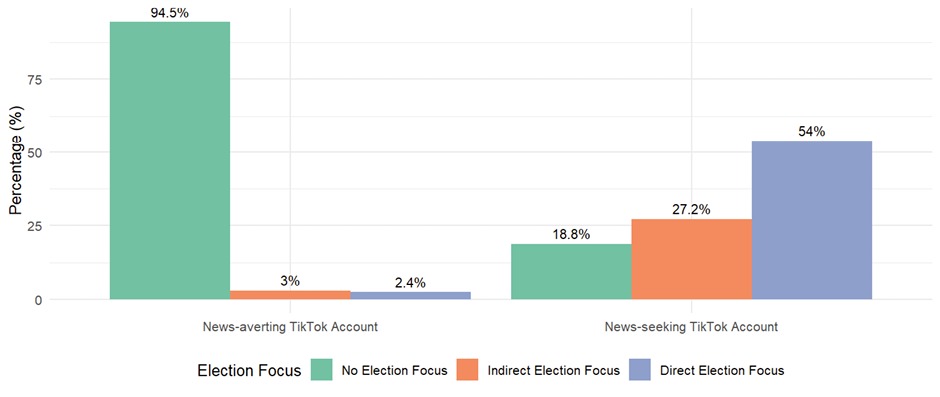
We find a large disparity in election content between the two accounts (Figure 1). Fewer than 6% of the videos recommended to the news-averting account were election related (2.4% direct and 3% indirect). By contrast, 81.2% of videos recommended to the news-seeking account carried election content (54% direct and 27.2% indirect). This suggests that TikTok’s algorithm did not proactively recommend election information to users without pre-established news interest signals, despite both accounts being located in Scotland.
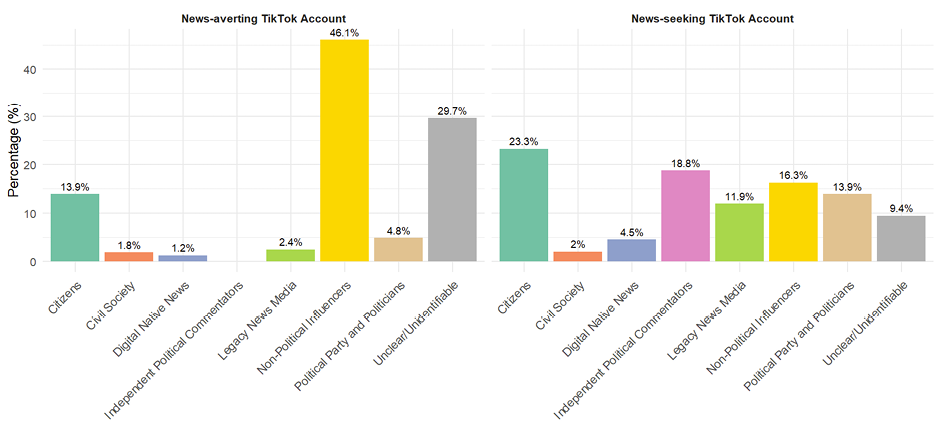
Source quality diverged significantly between the two accounts (Figure 2). The news-averting account received the majority of its content from non-institutional voices such as non-political influencers (46.1%) and citizens (13.9%), while legacy news (2.4%), political parties and politicians (4.8%), and digital native news outlets (1.2%) together accounted for fewer than 9% of recommendations.
The news-seeking account fared better. Content by political parties and politicians (13.9%) and legacy news media (11.9%) featured more prominently. But citizens (23.3%) and independent political commentators (18.8%) still outweighed institutionally accountable journalism. Notably, even this account, which repeatedly watched legacy news content, was steered algorithmically toward less-institutional, alternative voices in larger volume than toward the outlets it demonstrably preferred.
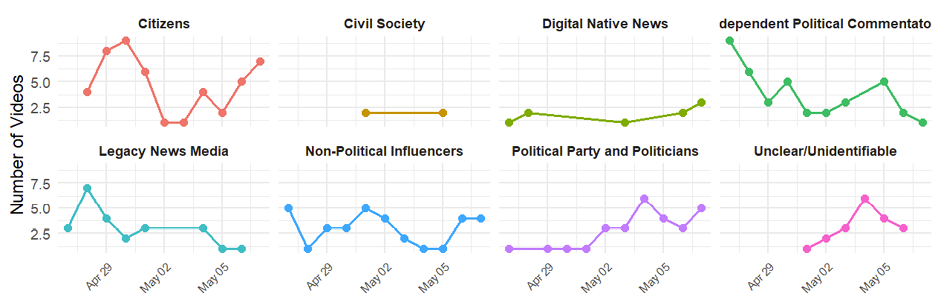
Our temporal analysis of the news-seeking account reveals a further pattern (Figure 3). Early in the observation, the news-seeking account received comparatively more content from legacy news and independent commentators. Over the 11 days, these declined and content from non-political influencers, citizens, and political parties and politicians increased. Northwestern University academics found that TikTok algorithms avoid recommending news even when users provide strong news interest signals. Our data extend this finding by showing that the degree of that under-recommendation may worsen over time.
Three implications follow from these findings. First, TikTok’s algorithmic logic creates a two-tier news information environment. Users already disengaged from news and politics receive significantly less election content, while engaged users receive substantially more. Unlike public broadcasting, the platform imposes no civic information floor, risking a deepening of existing news exposure gaps and participation.
Second, source quality is systematically deprioritised for both accounts. Content from sources operating without editorial oversight or institutional accountability consistently outranked established news organisations, even for users who sought it out. This suggests that news exposure is not simply a matter of audience preferences. It reflects an algorithmic logic that optimises for engagement than source credibility.
Third, the temporal shift in recommendation suggests TikTok is not a stable channel for credible news exposure during elections. Even for a news-seeking user, the FYP algorithm drifts over time from recommending institutional sources and toward more alternative, independent sources. News outlets invested in TikTok as a news distribution channel should be aware that algorithms may undermine their reach.
These findings should be interpreted as indicative rather than generalisable, given the exploratory nature of this study and limited sample size. Future research with larger, more demographically diverse account panels and longer observation windows would help establish the robustness of these patterns.
What’s at stake? Our data suggest that a news-averting Scottish voter could have encountered little election content through their TikTok FYP during the 2026 Scottish election. Even a news-seeking Scottish voter could have encountered fewer traditionally credible sources of election content through their FYP. This reflects that in the platform age, the gatekeeping function once exercised by professional journalism has been delegated to algorithms operating without public interest obligations. How regulators and public digital literacy efforts respond to this will be one of the defining questions of the coming decade.