Dr Jonathan Parker
Lecturer in Politics at the University of Glasgow. His research centres on political parties and party systems, with a focus on Scotland in a comparative European context. He is particularly interested in Green and new left parties, political cleavages and the impacts of electoral systems on voting behaviour.
Scottish Election 2026
Section 1: Parties and the campaign
- How SNP and Swinney stopped the rot (Eddie Barnes)
- The Scottish green wave breaks at last (Dr Jonathan Parker)
- What went wrong for Labour (Prof Kezia Dugdale)
- The Scottish Conservatives (Dr Alan Convery)
- Reform’s courting of Scotland’s post-industrial communities (Dr Maike Dinger and Prof Darren Lilleker)
- From chatbots to the ballotbox – how voters used AI to learn about the Scottish Parliament election (Dr Louise Luxton, Dr Timea Balogh, Elise Frelin & Prof Zoe Greene)
- Online advertising in the Scottish Parliament election (Kate Dimson and Prof Cristian Vaccari)
- Boring is not a virtue: Lessons from Scottish parties’ campaigns on TikTok (Prof Ana Ines Langer, Dr Lluis de Nadal)
- When parties travel, does negativity follow? Comparing campaigns on X (Dr Aybuke Atalay, Dr Ricardo Ribeiro Ferreira)
- Minding the distance: leaders in the election manifestos (Dr Michael Higgins, Prof Angela Smith)
- “It’s the Crisis, Stupid!” – Permacrisis and the 2026 Scottish Parliament election (Dr Paul Anderson, Dr Coree Brown Swan, Dr Judith Sijstermans
- ‘Whither Scottish national identity? The Reform UK challenge to an inclusive Scotland’ (Dr Murray Leith, Dr Duncan Sim)
- Environmental politics: flooded off the agenda? (Dr Kristen Nicolson)
- A disappearing crisis? Climate debate in the 2026 Scottish election campaign (Dr William Dinan)
- The Curious Case of the Co-operative Party and Lessons for Labour (Katharine McCrossan)
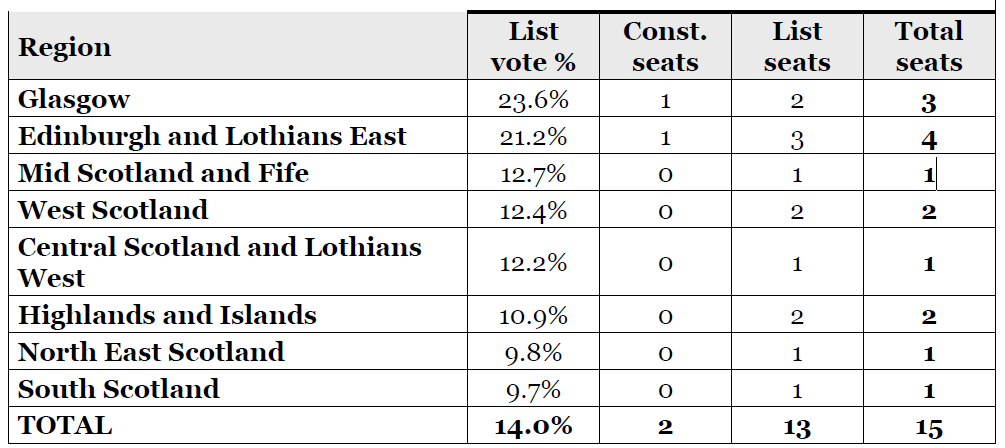
The 2026 election was by some margin the Scottish Green Party’s best ever electoral performance. For the first time, it won over 10% of the vote and more than 10 seats. Their 14% regional list vote share is the second-highest ever recorded by a green party in a national parliamentary election worldwide. The party’s 15 seats includes 2 constituency seats for the first time (Table 1), as well as the first transgender, non-binary and black MSPs. It also represents a generational shift within the party. Longtime leader Patrick Harvie stood down in 2025 and was replaced by Ross Greer and Gillian McKay, both in their early thirties. New young candidates were also given a high profile. Despite some internal tensions, the Greens ran one of their most targeted and effective campaigns to date, capitalising on growing dissatisfaction with the SNP among progressive-left pro-independence voters.
The Greens have been represented in the Parliament since its inception, but — apart from a brief surge in 2003 — remained a minor presence until the independence referendum. This event was crucial to the Green Party’s growth, with its membership and organisational capacity expanding significantly afterwards. The party subsequently established itself as the left flank of the pro-independence bloc, and its voters were overwhelmingly pro-independence in the 2016 and 2021 elections, especially among younger voters and graduates. From 2021-2024 the Greens and SNP co-operated in government until then-First Minister Humza Yousaf ended the arrangement.
However, leaving government allowed the Greens to distance themselves from the SNP. Campaign messaging was designed to appeal to former SNP voters who felt the party had become too moderate in office. Their appeal to progressive voters was further sharpened by strong criticism of the Labour Party for its rightward shift on LGBTQ+ and immigration issues. The Greens also positioned themselves as the direct antithesis of Reform UK — echoing strategies used by other left-libertarian parties — and benefited from growing polarisation on “GAL-TAN” (green-alternative-liberal vs traditional-authoritarian-nationalist) issues.
The manifesto also reinforced a left-progressive profile, combining increased public spending with proposals for wealth taxes, decentralisation and staunch support for women’s, LGBTQ+ and ethnic minority rights. Environmental concerns featured prominently in the manifesto but were rarely discussed on the campaign trail unless linked to cost-of-living issues. This reflects both the reduced salience of environmental concerns compared to previous elections and a deliberate “issue linkage” — a common tactic for parties seeking to broaden a core-issue identity.
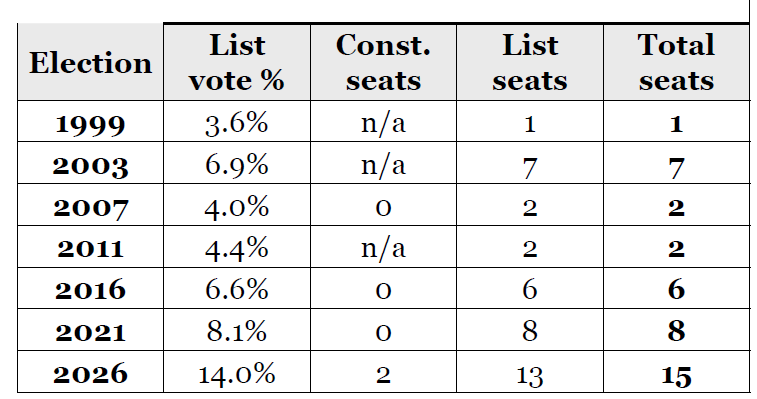
Historically the Greens focused on winning regional list seats (Table 2), standing few, if any, constituency candidates due to the cost of election deposits. In 2026, six constituencies were selected in which to run candidates — down from 12 in 2021 — but campaign effort in those seats increased substantially. There are significant incentives to doing so. Political culture affords constituency MSPs greater legitimacy, and the party wanted to dispel the common (though inaccurate) accusation that Green support is merely tactical list voting by SNP supporters. Two seats — Edinburgh Central and Glasgow Southside — were targeted, and both were won by significant margins. This was partly enabled by a significant increase in membership, which gave the party’s ground operations an organizational edge over opponents in those seats.
Despite the campaign’s overall success, elements of disorganisation and internal tension persisted. There were power struggles in the North East branches over list selections, and tensions between national and local parties over constituency nomination strategies. The national leadership sought to prevent non-target constituency candidates from campaigning actively, excluding them from party election materials. The decision was criticised by local activists and was partially reversed in Glasgow Kelvin and Maryhill in the final weeks.
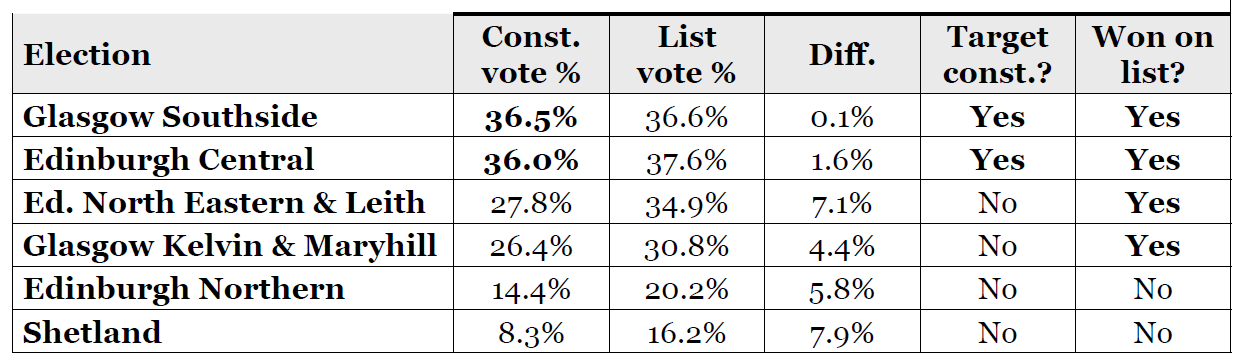
Given the SNP’s disproportionate gains in constituency seats, these disputes raise important questions about the party’s future constituency strategy. The Greens’ absence from many constituencies was at least partly why the SNP were able to sweep this tier. Notably, the gap between SNP constituency and list vote shares closely mirrors the Green list share in nearly all constituencies. Moreover, in five constituencies (of which four had Green candidates), the Greens were the most-voted party on the list. That only two of these were won by the party is likely a consequence of the decision to target only those seats. In targeted constituencies, where the Greens explicitly asked for both votes, constituency and list votes were near-identical, whereas in non-target seats the list vote was higher than the constituency vote (Table 3).
Nonetheless, this is an excellent result for the party, and the Greens will be a significantly larger presence in the next parliament — even if the Liberal Democrats’ success offers the government an alternative route to a majority on some policies. Going forward, the Greens will need to navigate the tension between being a pivotal parliamentary actor and maintaining their identity as a grassroots movement — a challenge familiar to many “new left” parties before them.