Dr Aybuke Atalay
Training Fellow at the Centre for Data, Culture & Society, Edinburgh Futures Institute, The University of Edinburgh. Her research examines digital campaigning, computational propaganda, and the role of automation and emerging technologies in political communication.
X: @aybukeatalayy
Email: aybuke.atalay@ed.ac.uk

Dr Ricardo Ribeiro Ferreira
Leverhulme Early Career Fellow at the University of Liverpool. His research examines the political communication dynamics driving democratic decline—particularly the instrumentalisation of journalism and the role of illiberal actors in shaping public deliberation—and what makes resistance to such erosion possible.
Scottish Election 2026
Section 1: Parties and the campaign
- How SNP and Swinney stopped the rot (Eddie Barnes)
- The Scottish green wave breaks at last (Dr Jonathan Parker)
- What went wrong for Labour (Prof Kezia Dugdale)
- The Scottish Conservatives (Dr Alan Convery)
- Reform’s courting of Scotland’s post-industrial communities (Dr Maike Dinger and Prof Darren Lilleker)
- From chatbots to the ballotbox – how voters used AI to learn about the Scottish Parliament election (Dr Louise Luxton, Dr Timea Balogh, Elise Frelin & Prof Zoe Greene)
- Online advertising in the Scottish Parliament election (Kate Dimson and Prof Cristian Vaccari)
- Boring is not a virtue: Lessons from Scottish parties’ campaigns on TikTok (Prof Ana Ines Langer, Dr Lluis de Nadal)
- When parties travel, does negativity follow? Comparing campaigns on X (Dr Aybuke Atalay, Dr Ricardo Ribeiro Ferreira)
- Minding the distance: leaders in the election manifestos (Dr Michael Higgins, Prof Angela Smith)
- “It’s the Crisis, Stupid!” – Permacrisis and the 2026 Scottish Parliament election (Dr Paul Anderson, Dr Coree Brown Swan, Dr Judith Sijstermans
- ‘Whither Scottish national identity? The Reform UK challenge to an inclusive Scotland’ (Dr Murray Leith, Dr Duncan Sim)
- Environmental politics: flooded off the agenda? (Dr Kristen Nicolson)
- A disappearing crisis? Climate debate in the 2026 Scottish election campaign (Dr William Dinan)
- The Curious Case of the Co-operative Party and Lessons for Labour (Katharine McCrossan)
Digital campaigning in elections has become increasingly negative, with parties frequently attacking their opponents’ policies and leadership. However, the UK’s distinctive constitutional arrangement complicates campaigning strategies between devolved and general elections. This raises the question of whether political campaigning styles remain consistent across electoral contexts. Evidence from the Scottish election campaign on the social media platform X suggests that, while some parties maintain relatively stable tones across elections, others adapt their approach substantially depending on the political dynamics of the contest.
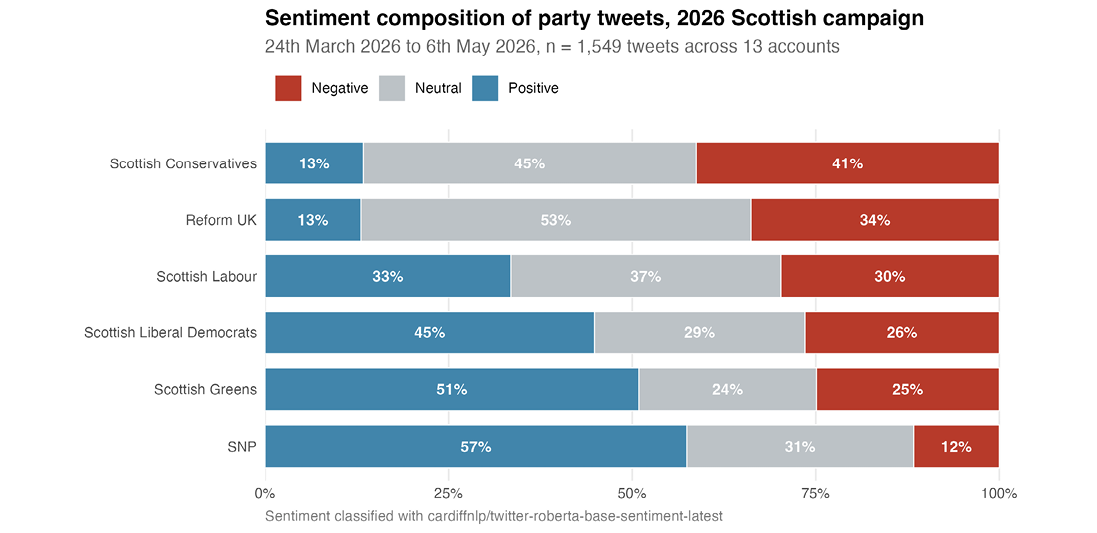
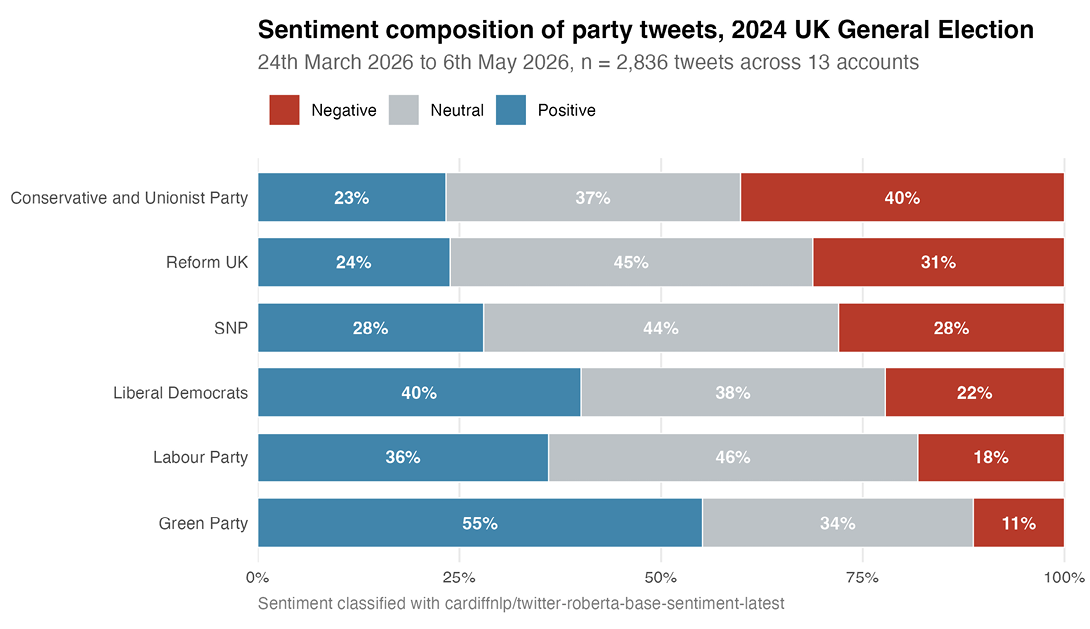
We analysed the tone of digital campaigning during the 2026 Scottish Parliament election and compared it with the 2024 UK General Election. We did so by classifying the sentiment of all original tweets posted on X during the respective official campaign periods by the official accounts of the main parties contesting each election and their leaders at the time (n = 4,385).
The Scottish campaign displayed a relatively clear distribution of campaigning styles across parties. The Scottish Conservatives relied most heavily on negative messaging, with 41% of their posts classified as negative, followed by Reform UK at 34%. By contrast, the Scottish National Party (SNP) ran the most positive campaign overall, with 57% of its posts classified as positive and only 12% as negative. Labour occupied a middle ground between these positions, while the Greens and Liberal Democrats also leaned more heavily toward positive campaigning.
What makes the Scottish election especially revealing, however, is how differently several parties campaigned compared with the 2024 UK General Election.
The clearest example is the SNP. Their campaign was 28% negative in 2024, when the party positioned itself as a challenger to both the Conservatives and Labour. This sharper tone likely reflects the SNP’s longstanding adversarial relationship with Westminster politics and its role as a pro-independence party critical of UK governance. As reported above, when defending its own Holyrood record this year, the SNP campaign was only 12% negative. That is a 16-point drop from one campaign to the next.
Labour has moved in the opposite direction. In 2024, with polls projecting a comfortable Westminster majority, Labour ran a classic front-runner campaign on X: 36% of their tweets were positive and only 18% negative. The strategic logic of a leading party was likely to avoid mistakes and look government-ready, not to attack—particularly when the incumbent Conservatives were already deeply unpopular. Two years later, Scottish Labour faced a very different race. They were not the projected winners for the Scottish Parliament but still challengers to a long-incumbent SNP. This explains their shift in tone: Labour’s campaign moved from 18% negative in the 2024 Westminster election to 30% negative in the Scottish contest, a 12-point increase.
Unlike Labour and the SNP, the Liberal Democrats, Conservatives and Reform UK displayed much greater consistency across the two elections. The Liberal Democrats remained predominantly positive, particularly through messages centred on policy proposals and leader-focused visibility tactics. Reform UK was predominantly negative in both contests, aligning with previous research showing that parties at the ideological extremes, particularly on the right, tend to rely more heavily on attack-oriented campaigning. The Conservatives also adopted a more negative campaigning style both as an incumbent in the UK election and a challenger in the Scottish one, potentially reflecting a shift further to the right under pressure from Reform UK. The Greens also remained predominantly positive overall, although their negativity more than doubled from 11% to 25% in the Scottish campaign. This sharper tone may be associated with the party’s recent efforts to position itself as the main anti-Reform voice in the country.
Taken together, the comparison between the Scottish and UK elections suggests that campaign negativity is shaped less by fixed party identity than by electoral context and political positioning. Parties entering an election as incumbents, challengers, front-runners or insurgents appear to adapt their tone accordingly, rather than carrying a single campaigning style across contests. The contrast between Holyrood and Westminster is especially revealing in this respect. In a multi-level political system such as the UK’s, devolved elections are not simply smaller versions of general elections. The same parties often communicate differently depending on the arena in which they compete, the opponents they face, and the political risks attached to the campaign itself.
Of course, the data do not capture the full complexity of digital campaigning, as they focus only on official party and leader accounts on a single platform. The topics that parties prioritise and the specific targets of negativity are also important parts of how digital campaigns operate. Even so, the patterns we observed still point to meaningful differences in how parties adapted their campaigning tone across different electoral contexts.