Dr Louise Luxton
Postdoctoral Research Associate, Department of Government and Public Policy at the University of Strathclyde. Her research focuses on gender and representation, political communication and party politics in comparative perspective.

Elise Frelin
PhD Candidate, Department of Government and Public Policy at the University of Strathclyde. Her research examines the content of political parties’ campaign materials and social media using advanced techniques for machine learning and quantitative text analysis.

Dr Timea Balogh
Postdoctoral Research Associate, Department of Government and Public Policy at the University of Strathclyde. Her research focuses on political communication, public opinion, and electoral behaviour in advanced industrial democracies, with particular interests in how information shapes democratic participation and representation.

Prof Zoe Greene
Professor and Director of the PLACE Lab for computational social science and machine learning at the University of Strathclyde. Find out more about her work at zoegreene.com and parliview.org for using AI to improve democratic transparency.

Scottish Election 2026
Section 1: Parties and the campaign
- How SNP and Swinney stopped the rot (Eddie Barnes)
- The Scottish green wave breaks at last (Dr Jonathan Parker)
- What went wrong for Labour (Prof Kezia Dugdale)
- The Scottish Conservatives (Dr Alan Convery)
- Reform’s courting of Scotland’s post-industrial communities (Dr Maike Dinger and Prof Darren Lilleker)
- From chatbots to the ballotbox – how voters used AI to learn about the Scottish Parliament election (Dr Louise Luxton, Dr Timea Balogh, Elise Frelin & Prof Zoe Greene)
- Online advertising in the Scottish Parliament election (Kate Dimson and Prof Cristian Vaccari)
- Boring is not a virtue: Lessons from Scottish parties’ campaigns on TikTok (Prof Ana Ines Langer, Dr Lluis de Nadal)
- When parties travel, does negativity follow? Comparing campaigns on X (Dr Aybuke Atalay, Dr Ricardo Ribeiro Ferreira)
- Minding the distance: leaders in the election manifestos (Dr Michael Higgins, Prof Angela Smith)
- “It’s the Crisis, Stupid!” – Permacrisis and the 2026 Scottish Parliament election (Dr Paul Anderson, Dr Coree Brown Swan, Dr Judith Sijstermans
- ‘Whither Scottish national identity? The Reform UK challenge to an inclusive Scotland’ (Dr Murray Leith, Dr Duncan Sim)
- Environmental politics: flooded off the agenda? (Dr Kristen Nicolson)
- A disappearing crisis? Climate debate in the 2026 Scottish election campaign (Dr William Dinan)
- The Curious Case of the Co-operative Party and Lessons for Labour (Katharine McCrossan)
AI chatbots – such as ChatGPT, Google Gemini, Microsoft Copilot, and Claude – are fast becoming part of our everyday lives. Citizens turn to these online tools for private conversations about relationships, medical advice, careers, and finances. Politics is no different. A recent study found that 13% of eligible voters report having used conversational AI to find information relevant to their vote choice during the 2024 UK general election. News reports from the campaign period indicate that politicians are in on it too, with both Scottish Labour and Conservative MSPs accused of relying on AI generated content.
As AI advances at pace, the implications for democracy deserve serious attention. Free and fair elections depend on citizens having access to accurate information about issues, parties, and candidates. Information is by no means in short supply. From newspapers to broadcasters, social media to podcasts, the contemporary political media environment is an overwhelming landscape for citizens to navigate and digest. Moreover, increasingly partisan news coverage and the proliferation of online misinformation have left many citizens uncertain about where to turn and what to trust.
Against this backdrop, the appeal of AI chatbots is easy to understand. These tools answer specific questions about politics quickly, clearly and in a friendly tone. Users can ask follow-up questions and clarify what they have learned, without the fear of judgement from friends and peers. In this sense, AI tools may genuinely democratise access to political information, lowering the barrier to engagement for many citizens, particularly those who feel most left out.
However, there are serious reasons for caution. Legitimate questions have been raised about the accuracy of the political information these tools produce, about ideological biases – both left and right – in their training data, and about the risk of outright fabrication, so-called “hallucinations”, which could actively mislead voters. Evidence shows that AI-driven conversations about politics are incredibly persuasive, raising further questions about how voters use these tools and what influence they may have on their political attitudes and vote choice.
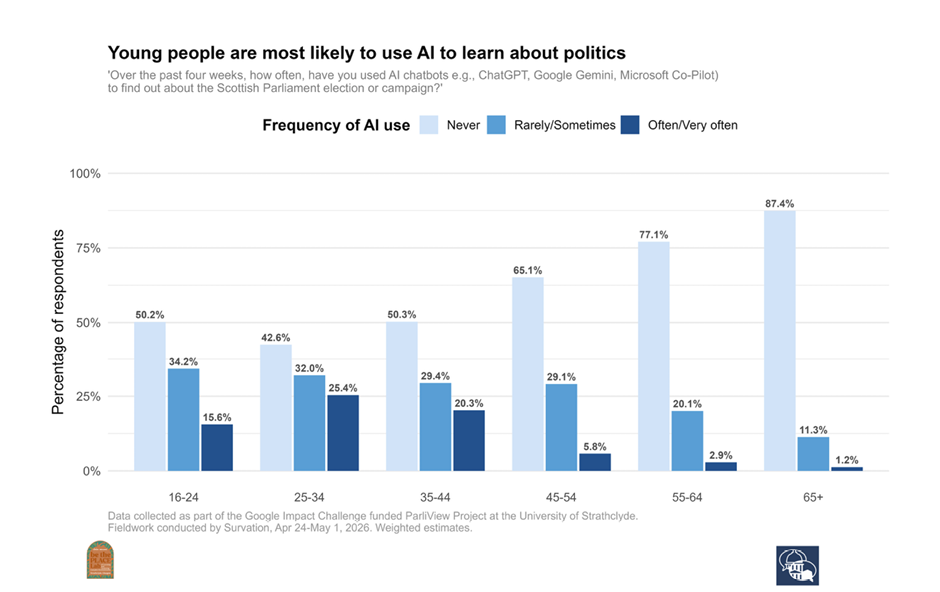
Whether and how citizens actually use such AI tools for acquiring political information remains somewhat of a black box. To shed light on these questions, we fielded a survey with Survation in the week before the Scottish election to better understand whether and how citizens used generative AI to learn about the election and campaign. See Figure 1.
The survey results indicate that AI chatbots are only an emerging source of election information but their usage is already significant among younger citizens. Overall, 71% of respondents reported never using AI chatbots for election-related purposes. Among those over 65 that was near 90%, with most relying on television or radio news, conversations with family and friends, or social media to learn about the campaign. Yet, 16% of 16-24 year-olds and 25% of 25-34 year-olds say they have used generative AI tools often or very often for information about the election and campaign.
Around one in ten respondents used AI chatbots to research parties’ policies, learn about candidates or party leaders, or fact check political claims. Most striking is that 7% of respondents – rising to 13% of 16-24 year-olds and 10% of 25-34 year-olds – report using an AI chatbot to help them decide who to vote for. This finding suggests that at least among certain groups, information generated by AI chatbots may have a significant effect on vote choice.
The current appeal of these tools seems to be primarily practical. Among those who used AI for political information, 44% say they did so because it is faster and 36% because it is easier to use than other sources. Perhaps the most revealing finding is that nearly a quarter of Scots consider AI more reliable and less biased than alternative information sources. This offers an intriguing insight into how disillusioned many citizens – and younger ones especially – have become with the mainstream media environment.
Whether citizens trust AI-generated political information is a more complex question. Overall, confidence in its accuracy is low: only 13% of respondents consider it completely or very accurate and 40% agree that it is biased. Intriguingly, scepticism is sharpest among the heaviest users. Belief in AI bias is highest among 16-24 year olds (48%) and 25-34 year olds (47%), the same groups most likely to use these tools.
This is not necessarily a contradiction. Younger citizens are heavier users of AI and familiarity with these systems may bring a clearer understanding of the limitations. As generative AI becomes more embedded in our lives and politics, the question that should concern us is where exactly the trade-off lies between the potential of these tools to make political information accessible to traditionally disengaged citizens and the serious concerns about accuracy and bias in systems whose inner workings remain opaque.
Politicians face a version of this trade-off too with 53% of 16-24 and 45% of 55-64 year olds indicating they are less likely to vote for a party or candidate that had used AI in their election campaign. This suggests the electoral costs of AI adoption may be just as real as the benefits.