Prof Ana Ines Langer
Professor of Political Communication at the University of Glasgow and co-founder of the Scottish Political Communication Network. Her research interests focus on how political actors use different types of media and how this, in turn, shapes the democratic process.

Dr Lluis de Nadal
Lecturer in Media, Culture and Society at the University of Glasgow. His research examines the intersection of media and democracy, including threats to information integrity and the impact of misinformation on support for climate action.
Scottish Election 2026
Section 1: Parties and the campaign
- How SNP and Swinney stopped the rot (Eddie Barnes)
- The Scottish green wave breaks at last (Dr Jonathan Parker)
- What went wrong for Labour (Prof Kezia Dugdale)
- The Scottish Conservatives (Dr Alan Convery)
- Reform’s courting of Scotland’s post-industrial communities (Dr Maike Dinger and Prof Darren Lilleker)
- From chatbots to the ballotbox – how voters used AI to learn about the Scottish Parliament election (Dr Louise Luxton, Dr Timea Balogh, Elise Frelin & Prof Zoe Greene)
- Online advertising in the Scottish Parliament election (Kate Dimson and Prof Cristian Vaccari)
- Boring is not a virtue: Lessons from Scottish parties’ campaigns on TikTok (Prof Ana Ines Langer, Dr Lluis de Nadal)
- When parties travel, does negativity follow? Comparing campaigns on X (Dr Aybuke Atalay, Dr Ricardo Ribeiro Ferreira)
- Minding the distance: leaders in the election manifestos (Dr Michael Higgins, Prof Angela Smith)
- “It’s the Crisis, Stupid!” – Permacrisis and the 2026 Scottish Parliament election (Dr Paul Anderson, Dr Coree Brown Swan, Dr Judith Sijstermans
- ‘Whither Scottish national identity? The Reform UK challenge to an inclusive Scotland’ (Dr Murray Leith, Dr Duncan Sim)
- Environmental politics: flooded off the agenda? (Dr Kristen Nicolson)
- A disappearing crisis? Climate debate in the 2026 Scottish election campaign (Dr William Dinan)
- The Curious Case of the Co-operative Party and Lessons for Labour (Katharine McCrossan)
Political communication is moving to new platforms, but our analysis of the 2026 Holyrood election on TikTok suggests parties’ campaigning remains stuck in an old problem.
Two decades ago, a study about TV political advertising asked why it was “so boring” that most viewers switched off. The question suited the political climate. Turnout at the 2001 UK general election had hit its lowest since 1918, party membership was falling, and the Third Way consensus had drained politics of much of its drama.
Today that question feels outdated. Populism and polarisation have flooded politics with emotion, often poisonously so, while campaigns increasingly advertise on platforms built to reward engagement. The “Tiktokification” of social media has only made things worse. Platforms have no public interest remit, and algorithms increasingly privilege interactions over followers and sideline political content, putting even more pressure on politicians to be entertaining or be ignored.
Regardless, some outsiders across the political spectrum have found ways to engage voters on TikTok. On one end, Javier Milei made his right-wing libertarian ideology appealing to disaffected young Argentinians through provocative, chainsaw-wielding performances, going from the political fringes to the Presidency. On the other end, democratic socialist Zohran Mamdani rose from obscurity to the New York Mayoralty by turning a relentless on-the-ground campaign into shareable moments of joyful enthusiasm. Different as they are, both reached voters by following TikTok’s rules and by appealing to their emotions. Neither was boring.
The same cannot be said about the candidates at the Holyrood election. Our content analysis of TikTok videos from the six main parties and their leaders found them to be exactly that: boring.
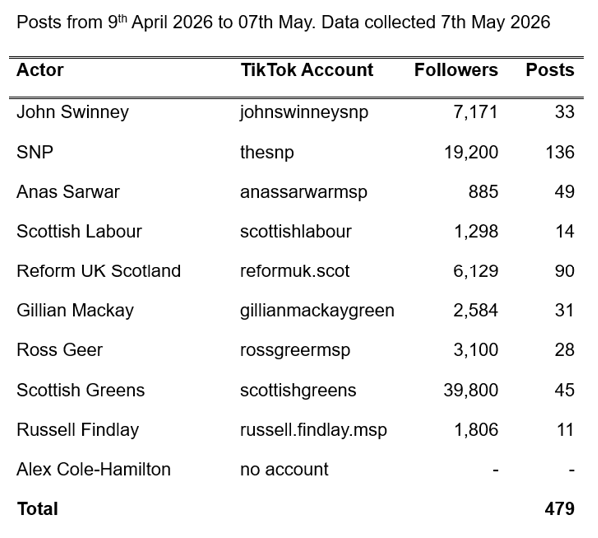
Our sample covered the dissolution of Parliament (9th April 2026) to election day (7th May 2026) and comprised 25% of the total videos, 12 per actor randomly selected, except for Russel Findlay, who posted only 11 (n =119). As Table 1 shows, none had a large following. For comparison, Mamdani has 3.5 million TikTok followers, Farage 1.4 million, and Kenny Boyle, Scotland’s most influential TikToker in 2025, over 160,000.
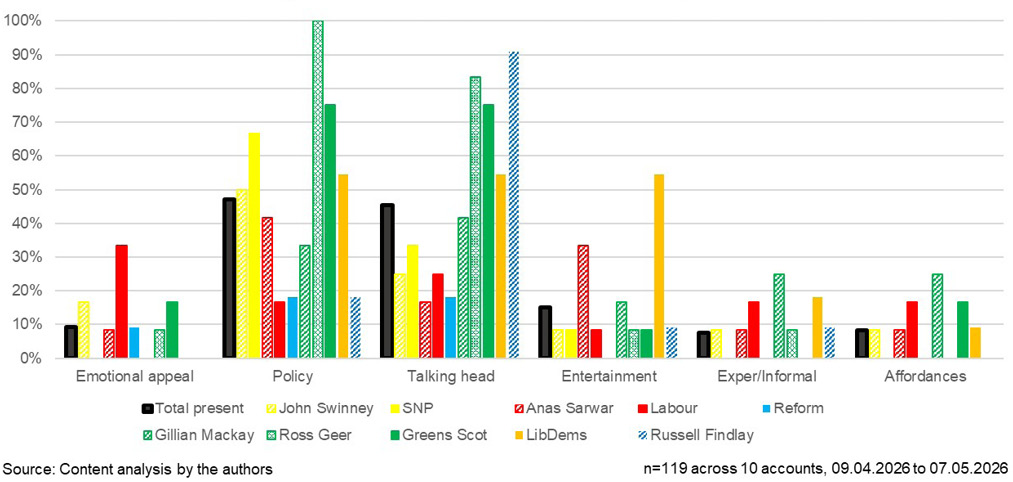
We coded videos along two dimensions. The first captures content and style, drawing on established categories in political advertising research: whether a video made emotional appeals to fear, anger, hope or pride; was dominated by policy detail; relied on a talking head format; attempted to entertain using humour or playfulness; or included lived experience, informality or unscripted moments. The second captures adoption of TikTok’s affordances, including effects, trending sounds, duets, stitches, and POV videos.
Of all the videos, nearly half were filled with policy detail, often feeling like manifesto pledges read aloud. A similar proportion were talking heads, with little variation beyond the occasional on-the-move selfie. Barely 9% made emotional appeals, and where they did it was often in words rather than sound or visuals, hardly the most effective vehicle. Only 15% attempted any form of entertainment, and rarely alongside the conventions that make content feel native to TikTok. Fewer than one in ten videos featured informality or lived experience, with affordances equally underused.
The sample is too small to reliably compare each account, but some differences stand out. The Scottish Greens and their co-leader Ross Greer were the most policy dense: 75% of the party’s videos and all of Greer’s included substantial policy detail. In addition, Greer was a talking head in 83% of his videos, though some adopted the slightly more engaging selfie walking format. Alex Cole-Hamilton, posting via the Scottish Liberal-Democrats account, scored highest on entertainment at 55%, followed by Anas Sarwar at 33%. But much of the content feels like the scripted and trying-too-hard kind that TikTok audiences will likely consider “cringe”. Greens’ Gillian Mackay, with informality and TikTok affordances present in 25% of her videos, fares slightly better—though hardly TikTok gold.
In some ways, especially in the current political climate, boring feels reassuring. But it would be a mistake for Scottish parties to congratulate themselves on a lacklustre TikTok campaign. If boring turned off voters two decades ago, in today’s fierce attention economy, where politics is increasingly invisible on platforms, it amounts to a death sentence—even more so given that young people are the heaviest consumers of the short, algorithm-driven video content saturating social media and, with the lowest turnout, the hardest to mobilise.
If parties fail to reach, algorithmically and emotionally, they need to reconsider how they communicate. Reaching voters in the age of TikTok is challenging but not impossible. Failing to do so is an invitation for voters to look elsewhere, whether that is the latest viral clip or, more troublingly, the outsiders weaponizing anxieties into the divisive content that algorithms reward. Democracies suffer when the political moderates switch off, because those at the extremes do not.
For our part, academics and commentators may also need to rethink what counts as normatively desirable. There is a risk we come across as advocating a dispassionate politics, as though the cure for overheated public debate is less emotion rather than better emotion, or boring over entertaining. Polarising messages and fake promises are not the only way to move voters; hope and solidarity can be just as stirring, especially when they feel in short supply. How to reach voters without cheapening the message for clicks or coming across as “cringe” has no easy answer, but that only makes the question even more important.
in TikTok