Dr Michael Higgins
Senior Lecturer and Programme Director of Media and Communication at the University of Strathclyde. He has published extensively on politics and media culture. His eighth book – Conflict Culture – is co-authored with Angela Smith and will be published by Routledge next year.
E: michael.higgins@strath.ac.uk

Prof Angela Smith
Visiting Reader at the University of Strathclyde and Professor Emeritus of Language and Culture at the University of Sunderland. Her publications range across language, politics, media and gender. Her most recent book is a critically acclaimed collection and commentary on the letters of Eileen O’Shaughnessy (with Sylvia Topp, Palgrave).
E: angela.smith@sunderland.ac.uk
Scottish Election 2026
Section 1: Parties and the campaign
- How SNP and Swinney stopped the rot (Eddie Barnes)
- The Scottish green wave breaks at last (Dr Jonathan Parker)
- What went wrong for Labour (Prof Kezia Dugdale)
- The Scottish Conservatives (Dr Alan Convery)
- Reform’s courting of Scotland’s post-industrial communities (Dr Maike Dinger and Prof Darren Lilleker)
- From chatbots to the ballotbox – how voters used AI to learn about the Scottish Parliament election (Dr Louise Luxton, Dr Timea Balogh, Elise Frelin & Prof Zoe Greene)
- Online advertising in the Scottish Parliament election (Kate Dimson and Prof Cristian Vaccari)
- Boring is not a virtue: Lessons from Scottish parties’ campaigns on TikTok (Prof Ana Ines Langer, Dr Lluis de Nadal)
- When parties travel, does negativity follow? Comparing campaigns on X (Dr Aybuke Atalay, Dr Ricardo Ribeiro Ferreira)
- Minding the distance: leaders in the election manifestos (Dr Michael Higgins, Prof Angela Smith)
- “It’s the Crisis, Stupid!” – Permacrisis and the 2026 Scottish Parliament election (Dr Paul Anderson, Dr Coree Brown Swan, Dr Judith Sijstermans
- ‘Whither Scottish national identity? The Reform UK challenge to an inclusive Scotland’ (Dr Murray Leith, Dr Duncan Sim)
- Environmental politics: flooded off the agenda? (Dr Kristen Nicolson)
- A disappearing crisis? Climate debate in the 2026 Scottish election campaign (Dr William Dinan)
- The Curious Case of the Co-operative Party and Lessons for Labour (Katharine McCrossan)
Political party campaign literature is in the business of attaching a face and personality to proposed policies. This has often taken the form of a photograph of the leader and their local disciple together. An exemplary pose is the candidate and the leader sitting behind a shared table, with two mugs in front of them. The implication is that they are spending enough time together to warrant a coffee, pretending to mull over national policy while no doubt raising the particular concerns of the constituents of East Glen Shoogly. Of course, the reality is a queue of candidates just off camera, each waiting on their moment within the orbit of power. But prosaic and faintly comic as such scenarios may be, the need for them is revealing of party institutional cultures, and of the attitudes towards party leadership.
The foregrounding of leaders is even more revealing in Scotland, where there are two leaders to choose from: the Westminster-based UK party and Holyrood-based Scottish party. The choice should be straightforward enough, since the Westminster iteration of a party has a negligible relevance in a Holyrood election. Yet, the Westminster leader normally enjoys high public recognition and includes the sitting Prime Minister. However, the popularity of a party as a whole does bear on their devolved Scottish fortunes, with past evidence that unpopular UK governments damage electoral prospects at the devolved level.
In contemporary media terms, the most prominent role for the leaders in the election is their place in the pre-arranged media interviews and debates. BBC Scotland hosted an election Leaders Special on 12th April, followed by Channel 4’s Scotland Decides on 14th April, and STV (Scottish Television) Leaders’ Debate on 28th April. All featured the Scottish leaders standing for election to Holyrood: the Scottish Conservatives (Russell Findlay), Scottish Greens (Ross Greer or Gillian Mackay), Scottish Labour (Anas Sarwar), Scottish Liberal Democrats (Alex Cole-Hamilton), Scottish National Party (John Swinney) and Reform UK (Malcolm Offord). These debates certainly played a role in setting a tone for the election – ill-tempered in this case – and in contributing to the media agenda. Indeed, with a seemingly negligible effect on his electoral fortunes, Reform UK Scottish leader Offord attracted an intense flurry of coverage after a misstep in STV debate in which he boasted of owning “six houses, three boats and five cars” to an audience worried about rising living costs.
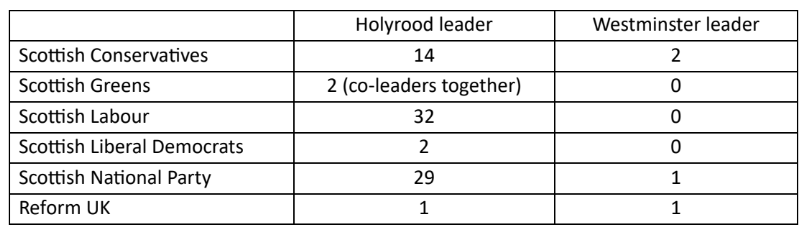
Far more reflective of party choice on personnel and individual salience is the use of leaders in party literature. Taking the most superficial but vivid measure of visibility, these are the numbers of photographic appearances of party leaders in the election manifestos. Images of both Holyrood (Scottish) and Westminster (UK) leaders were counted.
The Conservatives, Labour and the SNP – the conventional parties of government – are keenest on showing off their leaders (portrayed in a variety of political and public-facing adventures). The SNP also have an image of their Westminster leader Stephen Flynn within a group shot in his new role as Holyrood candidate. However, two parties more than the others show the challenges and opportunities of negotiating the Holyrood/Westminster relationship. First, Scottish Labour leader Anas Sarwar had already set an unaccommodating tone by asking for the resignation of UK leader and Prime Minister Kier Starmer in the February before the election. Perhaps unsurprisingly, the manifesto was launched by Sarwar alone, and the Scottish Labour election manifesto was festooned by images of Sarwar (32) and none of Starmer.
Second, the Reform UK manifesto is surprisingly light on leader images. Reform UK leader Nigel Farage has been highly prominent in the election, perhaps more than any Westminster-based leader has been in an election to Holyrood. For all that, Farage appears in the manifesto just once, standing side by side with Scottish leader Malcolm Offord. Reform UK’s campaign aesthetic is seen to benefit from the Farage brand and, in contrast to Scottish Labour’s strategy, UK leader Farage also presented the face of Reform UK at the Scottish manifesto launch in May.
A fuller study of leader visibility is required to understand such factors the role of non-conventionality in ensuring prominence for Reform UK and its leadership, in a manner not reflected in the layout of their manifesto. For Scottish Labour’s part, a dominance of Sarwar over Starmer seems to have yielded little positive response from voters. Nonetheless, in letting us know how parties wish to project leadership, manifestos tell us more than just policies.
PDF versions)
