Katie Dimson
Recent graduate of the University of Edinburgh, where she studied Economics and Politics. Her research examines digital political communication, with a focus on election campaigns on Meta.

Prof Cristian Vaccari
Chair of Future Governance, Public Policy, and Technology at the University of Edinburgh. He studies political communication by elites and citizens in comparative perspective, with a particular focus on digital and social media.
Scottish Election 2026
Section 1: Parties and the campaign
- How SNP and Swinney stopped the rot (Eddie Barnes)
- The Scottish green wave breaks at last (Dr Jonathan Parker)
- What went wrong for Labour (Prof Kezia Dugdale)
- The Scottish Conservatives (Dr Alan Convery)
- Reform’s courting of Scotland’s post-industrial communities (Dr Maike Dinger and Prof Darren Lilleker)
- From chatbots to the ballotbox – how voters used AI to learn about the Scottish Parliament election (Dr Louise Luxton, Dr Timea Balogh, Elise Frelin & Prof Zoe Greene)
- Online advertising in the Scottish Parliament election (Kate Dimson and Prof Cristian Vaccari)
- Boring is not a virtue: Lessons from Scottish parties’ campaigns on TikTok (Prof Ana Ines Langer, Dr Lluis de Nadal)
- When parties travel, does negativity follow? Comparing campaigns on X (Dr Aybuke Atalay, Dr Ricardo Ribeiro Ferreira)
- Minding the distance: leaders in the election manifestos (Dr Michael Higgins, Prof Angela Smith)
- “It’s the Crisis, Stupid!” – Permacrisis and the 2026 Scottish Parliament election (Dr Paul Anderson, Dr Coree Brown Swan, Dr Judith Sijstermans
- ‘Whither Scottish national identity? The Reform UK challenge to an inclusive Scotland’ (Dr Murray Leith, Dr Duncan Sim)
- Environmental politics: flooded off the agenda? (Dr Kristen Nicolson)
- A disappearing crisis? Climate debate in the 2026 Scottish election campaign (Dr William Dinan)
- The Curious Case of the Co-operative Party and Lessons for Labour (Katharine McCrossan)
Social media have become a key avenue to reach voters, and parties invest substantial funds and effort to advertise on these platforms. In this article, we shed light on how the six main Scottish parties campaigned on Facebook and Instagram, used by 71% and 53% of Scottish residents, respectively. We ask how intensely the parties advertised, how much they spent, and which groups they reached in the 2026 Holyrood election.
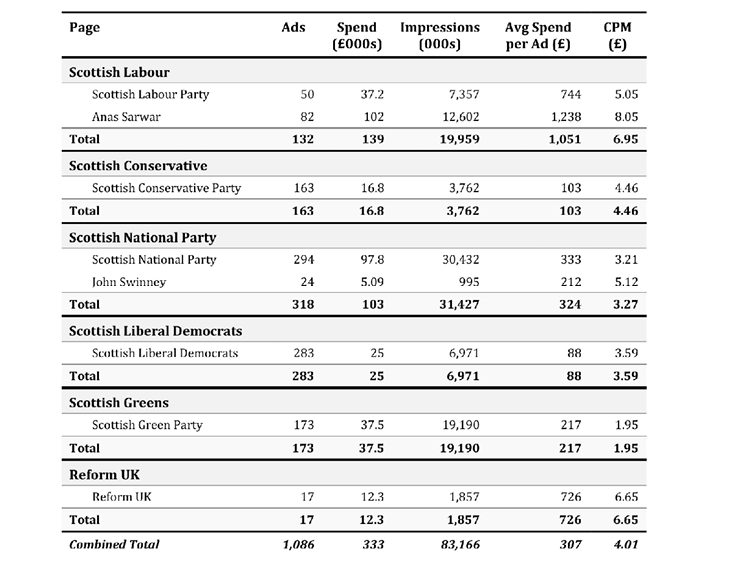
To answer these questions, we extracted data from the Meta Ad Library (MAL), a publicly accessible archive of advertisements “about social issues, elections or politics” across Facebook and Instagram. The dataset includes N=1,086 ads published between the 9th April 2026 (dissolution of Parliament) and the 4th May 2026 (three days before the election) by Scottish Labour, Scottish Conservatives, Scottish National Party, Scottish Greens, and Reform UK, alongside leaders John Swinney (SNP) and Anas Sarwar (Scottish Labour). Swinney and Sarwar were the only two party leaders who advertised during the campaign, and we include them to understand how their approaches differed from their parties’ (see Table 1). As Reform UK did not use its Scottish-based profiles to advertise on Meta platforms during the campaign, its figures reflect ads from its UK-wide account for which at least 75% of impressions were delivered in Scotland.
Advertisers frequently repurchase ads with identical creative content while varying delivery parameters. Thus, ad counts reflect distinct delivery trajectories rather than visually unique ads. Moreover, the MAL provides impressions and spending in ranges, and aggregates viewers’ age into six groups. It also does not report targeting parameters per individual ad. Such “coarseness in the data” introduces some imprecision, but still enables us to uncover suggestive evidence of campaign strategies and audience composition.
During the period we covered, Scotland’s main parties and leaders collectively spent £333,000 across Facebook and Instagram advertising, generating over 83 million impressions. Spend and reach diverged considerably across advertisers (Table 1).
The SNP ran the largest campaign by volume, producing 31.4 million impressions from 318 ads at a cost per thousand impressions (conventionally known as Cost per Mille, or CPM) of £3.27. Its operation was overwhelmingly party-led, with John Swinney’s personal page contributing just £5,090 of the £103,000 total. Overall, Scottish Labour’s campaign was both the most expensive (£139,000) and the least cost-effective among the main parties (with a CPM of £6.95). Anas Sarwar’s personal page, which accounted for over 70% of Labour’s total campaign budget, ran ads at a higher average spend (£1,238 against £744 for the party account) and a substantially higher CPM (£8.05 against £5.05).
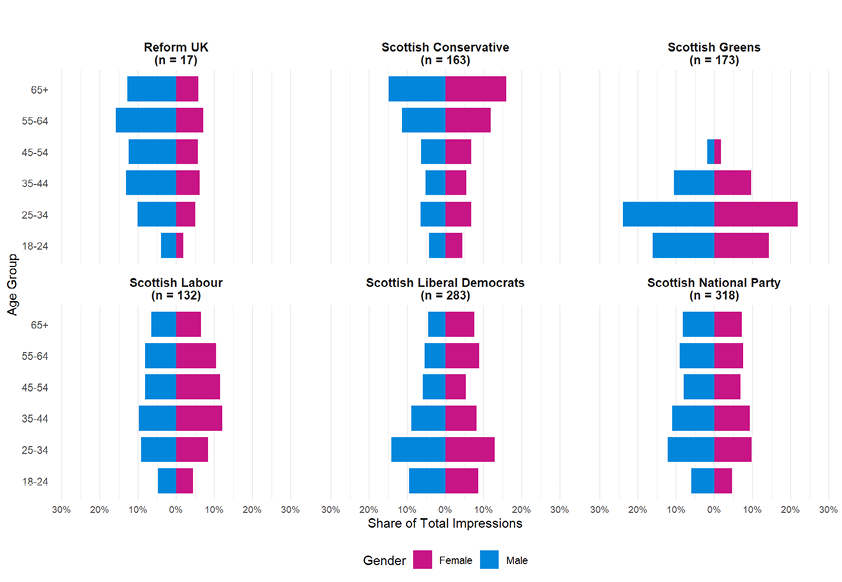
The Scottish Greens achieved the greatest efficiency, generating 19.2 million impressions from just £37,500 at a CPM of £1.95, the lowest in the dataset. The Scottish Liberal Democrats spent the least per ad at £88, while the Scottish Conservatives spent £103 per ad, potentially suggesting more differentiated strategies. Reform UK ran the smallest campaign with just 17 ads and one of the highest CPMs at £6.65, suggesting heavily boosted posts to more expensive audiences. Age and gender profiles (Figure 1) may explain some of these differences.
The Scottish Greens reached by far the youngest audience, with more than three-quarters of impressions delivered to users under 35, around 30% to 18-24-year-olds alone, and no ads delivered to users above 55 years of age. This may explain their low CPM, as younger users can be cheaper to target on Meta platforms. Conversely, the Scottish Conservatives reached the oldest age profile, with over half of impressions going to users aged 55 and above. The SNP and Scottish Liberal Democrats produced more even distributions across adult age groups, while Scottish Labour skewed slightly older, with a stronger focus on the 35-44 and 45-54 cohorts. Notably, Sarwar’s ads reached older audiences than the party account, which may also explain the higher CPM of his page relative to that of his party.
Most parties’ ads reached similar proportions of male and female voters. Reform UK was the clearest exception, with around 68% of impressions reaching male users, though the small sample of 17 ads warrants caution. The SNP’s campaign also reached slightly more male voters with 55% of impressions. Conversely, 53% of Scottish Labour’s ads’ impressions were seen by female users.
The 2026 Holyrood campaign confirmed that social media advertising is now embedded in Scottish electoral politics, with parties diverging markedly in spending, efficiency, and audience reach even as overall demographic profiles often converged. The Greens courted the young, the Conservatives the old, and Reform UK overwhelmingly the male. These outcomes reflect not only party intentions but also the interaction between campaign strategies, party resources, and platform algorithms. As these channels become increasingly central for political communication, disentangling these mechanisms poses a growing challenge for the transparency of contemporary campaigns.