
Prof Sir John Curtice
Professor of Politics at Strathclyde University and Senior Fellow, Scottish Centre for Social Research and “The UK in a Changing Europe”. He has a particular interest in the geography of electoral performance and its impact on the operation of electoral systems.

Scottish Election 2026
Section 3: Voters, polls and the electoral system
- Elections and voting as rituals: Comparing Scotland with Australia (Prof Ariadne Vromen)
- The electoral system: The most disproportional result yet (Prof Sir John Curtice)
- The system is working (as intended): What Scottish voters actually wanted on 7 May 2026 (Prof Christopher Carman, Prof Ailsa Henderson)
- The Meh election? Campaign dynamics in the 2026 Scottish Parliament election (Prof Christopher Carman, Prof Robert Johns)
- MRPs: a false dawn (Dr Eoghan Kelly)
- Changing electoral battlegrounds: The rise and fall of extreme two-party contests (Prof Ailsa Henderson)
- Distinctively left-wing? Comparing young Scottish people to the rest of the UK and older Scots (Dr Joe Greenwood-Hau)
- Scotland: A country of aging disruptors? (Dr Jan Eichhorn)
- Shifting tides: Gender, independence and constitutional politics in the 2026 Scottish election (Dr Emilia Belknap)
- Why did Reform make a breakthrough? Evidence from the Scottish Election Study (Dr Fraser McMillan)
- Mapping Reform UK’s vote in the 2026 Scottish Parliament election (Dr Davide Vampa)
- The SNP: hegemony in a time of crisis? (Dr Sebastian Dellepiane-Avellaneda, Prof Anthony McGann)
In the event, the SNP did not win the overall majority John Swinney sought. However, between them the SNP and the Greens won 73 seats, 57% of all MSPs. It is the largest ever contingent of pro-independence MSPs at Holyrood.
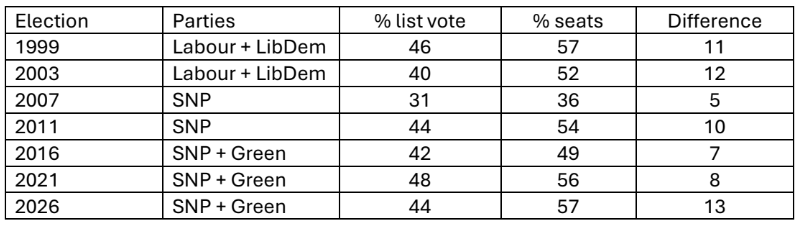
Yet between them the two parties won just 41% of the regional list vote. The avowed aim of the parliament’s mixed member proportional electoral system is to produce a distribution of seats proportional to each party’s share of the list vote. However, as Table 1 shows, this is not the first time disproportionality has benefitted the party of government and its potential allies. However, it is the biggest discrepancy yet, even greater than that which favoured the Labour/Liberal Democrat coalition at the first two Holyrood elections.
Why was the outcome so disproportional? The reason lies primarily in the outcome in the constituencies. The first-past-the-post system used to elect constituency MSPs reflects a party’s standing relative to its competitors rather than simply the share of the vote it has won. Despite winning a relatively modest 38% of the constituency vote across Scotland, the SNP had a large, 19 point, lead over its nearest rival, Labour. Given also that SNP support is geographically relatively evenly spread, such a gap was inevitably going to mean the party would win the vast bulk of the constituency seats. Only those where one of its opponents was especially strong locally were likely to avoid its grasp.
In the event, the SNP won 57 constituencies. In contrast, if in every constituency the rises and falls in each party’s support had matched exactly what happened across Scotland as a whole, the SNP would have won four more, 61 seats. Geographical variation in the parties’ performances did reduce the SNP tally somewhat – though in the Highlands & Islands the SNP found itself compensated for its resultant net loss of one seat in the allocation of list seats, leaving the party with its final total of 58 seats. Overall, the geographical variation in party performance resulted in the SNP being three seats down on what would otherwise have happened.
Two of these losses were to the Greens – one in Edinburgh and one in Glasgow. As it happened, however, the resultant reduction in the SNP’s representation in Edinburgh paved the way for the Greens to pick up a regional top-up seat on which they would otherwise have narrowly lost out. Only the second extra SNP loss in the capital (to the Liberal Democrats) served to reduce the tally of pro-independence MSPs. However, the Green success in Glasgow Southside enabled Labour to gain a top-up seat and thus did reduce the pro-independence tally by another seat.
In short, the gains and losses of constituency seats that arose as a consequence of locally exceptional party performance reduced the total tally of pro-independence MSPs by two – and thus helped to reduce the scale of the disproportionality in favour of pro-independence MSPs. Nevertheless, the large tally of pro-independence MSPs was wholly unsurprising given the party’s tallies on the constituency vote.
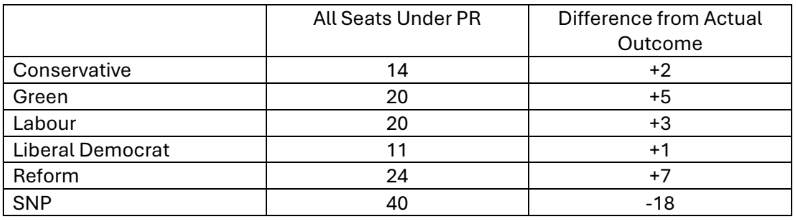
At the same time, however, the SNP’s share of the regional list vote was a record 11 points below that in the constituencies. This further served to increase the pro-independence disproportionality. In Table 2, we show what would have happened if all the seats in each of the eight regions had been distributed by proportional representation. In effect it shows what would have happened if the electoral system was achieving its stated aim. The SNP would have won 18 fewer seats, scattered across every region apart from Highlands & Islands. In contrast, the over-representation enjoyed by the SNP in 2021 was just four seats. The combined tally of SNP and Green seats would have been just 60, 13 down on their actual total and five short of a majority.
Holyrood’s electoral system was devised by Labour and the Liberal Democrats in the Scottish Constitutional Convention. Initially it served their interests well. However, after landing the SNP a majority in 2011 on just 44% of the vote, it has now, on the same tally, given the SNP and the Greens the largest ever majority of pro-independence MSPs. The first law of politics is the law of unintended consequences.
A version of this article has been published in The Conversation under a Creative Commons Attribution-No Derivatives licence [here].
