Prof Ariadne Vromen
Professor Ariadne Vromen is Head of the Division of Political and International Studies at the University of Glasgow. A political sociologist with a long-term interest in citizen engagement and elections, she moved to Glasgow from Sydney, Australia in early 2025. She was impressed that non-citizens can vote in Scotland.
Scottish Election 2026
Section 3: Voters, polls and the electoral system
- Elections and voting as rituals: Comparing Scotland with Australia (Prof Ariadne Vromen)
- The electoral system: The most disproportional result yet (Prof Sir John Curtice)
- The system is working (as intended): What Scottish voters actually wanted on 7 May 2026 (Prof Christopher Carman, Prof Ailsa Henderson)
- The Meh election? Campaign dynamics in the 2026 Scottish Parliament election (Prof Christopher Carman, Prof Robert Johns)
- MRPs: a false dawn (Dr Eoghan Kelly)
- Changing electoral battlegrounds: The rise and fall of extreme two-party contests (Prof Ailsa Henderson)
- Distinctively left-wing? Comparing young Scottish people to the rest of the UK and older Scots (Dr Joe Greenwood-Hau)
- Scotland: A country of aging disruptors? (Dr Jan Eichhorn)
- Shifting tides: Gender, independence and constitutional politics in the 2026 Scottish election (Dr Emilia Belknap)
- Why did Reform make a breakthrough? Evidence from the Scottish Election Study (Dr Fraser McMillan)
- Mapping Reform UK’s vote in the 2026 Scottish Parliament election (Dr Davide Vampa)
- The SNP: hegemony in a time of crisis? (Dr Sebastian Dellepiane-Avellaneda, Prof Anthony McGann)
In this article I reflect on the experience of being a first-time voter in Scotland. In early 2025 I moved to Scotland from Australia where I had my political socialisation, and have actively voted for 30 years. To reflect on voting in a new context I used research on elections as rituals and symbolic social practices. This focuses on how elections are staged, and how people understand the “rules of the game” through the phases of a campaign: learning who the actors are on the stage, the campaign, and its results. By looking at election experiences this way, we better understand what we normalise and think of as accepted election practice, despite that symbolic meanings are highly variable in different contexts.
Florence Faucher and Colin Hay compared elections in France and the UK to understand the role played by symbols and rituals, they write: “Voting day mobilises an entire community of citizens in a given political system around an event that combines unity of time, place, action, and which culminates in the designation of legitimate political representatives”. They describe three phases for interpreting an election: the campaign, the voting act, and the results. But prior to the campaign is the question of citizenship and the meaningfulness of being allowed to vote.
I moved to Glasgow for my job. I am on a working visa and permanent residency (AKA leave to remain) is a few years away. I am not a UK citizen. I am an Australian citizen. But for the Scottish election I had citizenship rights and was entitled to vote. Very few countries let non-citizen permanent residents vote, a handful let non-permanent residents vote, with the entitlement only won after 5 years of residency. The 2020 electoral reform in both Wales and Scotland enabled any legal residents to register and vote – no other country in the world does this.
So why did I choose to register? Besides being a political scientist, I have been socialised into a compulsory voting context in Australia. Voting has been compulsory for over 100 years, and is accepted as a social and political norm. Turnout is regularly over 95% despite the fine for not voting being only £10. In most countries, turnout relies on campaigns to “get out the vote”, meaning citizens need to feel motivated by a candidate or party they believe in. In Scotland’s 2026 election turnout was 53%, a decline from the 2021 election high of 63%; there was only one seat, my constituency of Glasgow Kelvin and Maryhill, where turnout increased. This was partly due to a genuine 3-way Green/SNP/Labour local electoral contest, but the election generally suffered from voter disenchantment or what’s called “the scunner factor”. Non-participation in an election is a symbolic act in of itself.
Ritual Phase 1: How did we know there was an election on? The staging of this election campaign was muted. While there was regular media analysis of the candidates, release of policy manifestos, and active social media engagement by academic experts, the visibility of the campaign and candidates was low. I learnt how to vote for my Constituency and Region via a mailed Voting Guide from the UK Electoral Commission. I also received a lot of direct mail: in Scotland, each constituency candidate is entitled to free postage for one “election communication” to voters in their constituency. Unlike the Australian context, I saw barely any posters, banners or street advertising for candidates and parties. The disengaged could have missed that there was an election on.
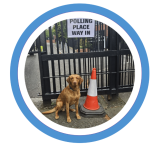
Ritual Phase 2: Faucher and Hay wrote that election day “rituals mobilise affective, psychological, and cognitive dimensions that contribute to the internalisation of ways of behaving”. Election day is the legitimate expression of voter choice on who we want to represent us in democratic politics. Voting was cognitively familiar: I went to the local school hall, stood in a private booth to mark my ballot papers, and put them into a locked box. But the affect was starkly different as there was no election carnival atmosphere: there were only two party campaigners handing out how to vote information, there was no “democracy sausage” or fundraising cake stalls, it was a work day (Thursday) not a Saturday, and there were no queues as many had sent a postal vote. Voting was a solo, private ritual.
Ritual Phase 3: Faucher and Hay wrote that “performance makes elections playful”, often seen in vote counting and the announcement of results. We watch results unfold online or on television, as elections are mediatised and scrutinised. Votes were not counted in Scotland after booths closed at 10pm, they were counted the next day and results announced mid-afternoon Friday. In Australia booths close at 6pm, the votes are counted and results usually known by 9pm Saturday. I spent Friday on the BBC and Scotsman election websites, learning about constituencies all over Scotland. The most distinctive election ritual was all candidates wearing their party rosettes, standing on stage to hear the constituency results read out. This ritual reminds us that elections are an adversarial competition for representation, but also deeply human. To counter disenchantment with politics and elections we need to focus on bringing people back in, ensuring they feel truly heard.
