
Dr Joe Greenwood-Hau
Lecturer in the John Smith Centre at the University of Glasgow. He works on the annual UK Youth Poll and delivers the associated honours course. Previously, he researched political (non-)participation, worked in polling, and taught political behaviour, survey methods, and statistical analysis.

Scottish Election 2026
Section 3: Voters, polls and the electoral system
- Elections and voting as rituals: Comparing Scotland with Australia (Prof Ariadne Vromen)
- The electoral system: The most disproportional result yet (Prof Sir John Curtice)
- The system is working (as intended): What Scottish voters actually wanted on 7 May 2026 (Prof Christopher Carman, Prof Ailsa Henderson)
- The Meh election? Campaign dynamics in the 2026 Scottish Parliament election (Prof Christopher Carman, Prof Robert Johns)
- MRPs: a false dawn (Dr Eoghan Kelly)
- Changing electoral battlegrounds: The rise and fall of extreme two-party contests (Prof Ailsa Henderson)
- Distinctively left-wing? Comparing young Scottish people to the rest of the UK and older Scots (Dr Joe Greenwood-Hau)
- Scotland: A country of aging disruptors? (Dr Jan Eichhorn)
- Shifting tides: Gender, independence and constitutional politics in the 2026 Scottish election (Dr Emilia Belknap)
- Why did Reform make a breakthrough? Evidence from the Scottish Election Study (Dr Fraser McMillan)
- Mapping Reform UK’s vote in the 2026 Scottish Parliament election (Dr Davide Vampa)
- The SNP: hegemony in a time of crisis? (Dr Sebastian Dellepiane-Avellaneda, Prof Anthony McGann)
Young Scots prioritise the same bread-and-butter issues as their counterparts in the rest of the UK, as well as older Scots, but they are more left-wing ideologically and in their voting intentions.
The 2026 Scottish Parliament elections were, perhaps, the last elections in the UK in which 16- and 17-year-olds in Scotland could vote whilst their counterparts in England could not. By the next Westminster general election, the voting age will have been lowered to 16 across the UK. This is an apt moment, then, to compare the political preferences of young people in Scotland and the rest of the UK. This is especially so because the different performances of political parties in Scotland from in the rest of the UK, and particularly the lower vote share for Reform UK, raises questions about the differing electoral preferences of Scots and the young people amongst them.
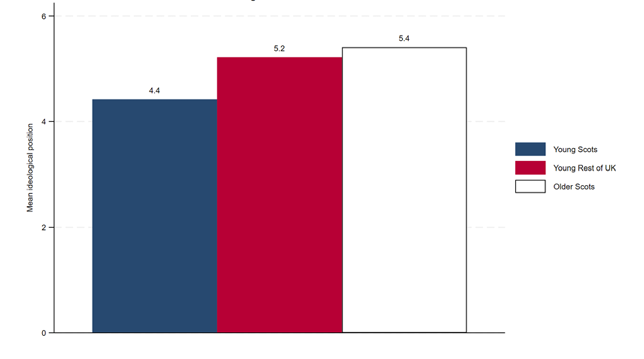
To investigate the distinctiveness of young Scottish people’s political preferences, we can take advantage of a convenient coincidence in the timing of the latest Scottish Election Study Opinion Monitor and annual John Smith Centre UK Youth Poll, which both took place in February. Combining these datasets gives us a sub-sample of 331 young Scottish people (aged 16 to 29) to compare against 1,935 young people in the rest of the UK and 1,302 older Scottish people (aged 30 and above). So, what does the data tell us about whether young Scottish people are politically distinctive from these other two groups? See Figure 1.
Three questions were asked similarly in both surveys, allowing us to compare answers across samples, starting with self-identified left-right ideology. As Figure 1 shows, young Scottish people are distinctive in their average self-identification. They are whole point more left wing than their older compatriots on a 1-10 scale (1 meaning left, 10 meaning right) and almost a whole point more left-wing than young people in the rest of the UK. Aged 16 to 29, this is the generation that came of political age around the 2014 Scottish independence referendum and thereafter. The political socialisation of this era may have made them distinctively left-wing, at least in how they identify.
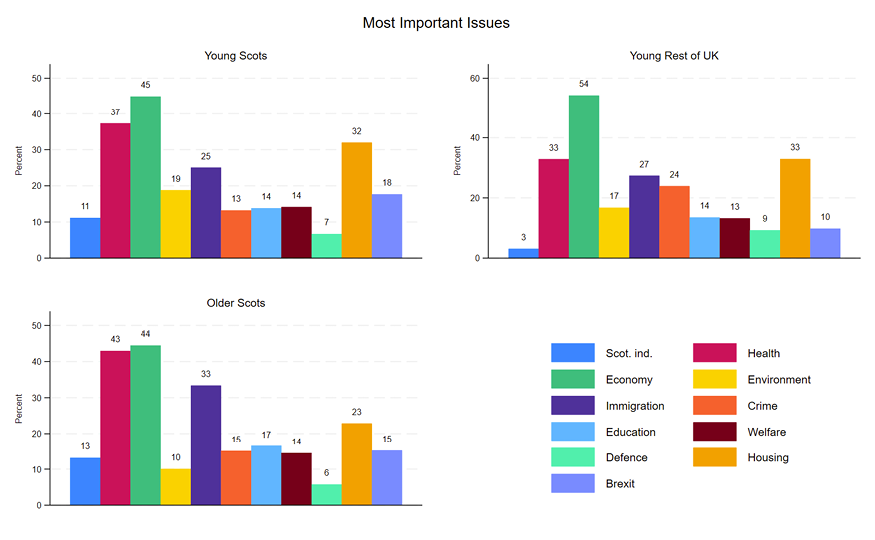
The second question covers the most important issues facing the UK.1 Figure 2 shows that, despite some notable differences in the percentages who select each option, similar issues are prioritised. In all three groups, the economy is the most selected issue. A higher percentage of young Scottish people select health than is the case amongst young people in the rest of the UK but neither group selects it as much as older Scots. Both groups of young people select housing as the next most (or equally) important issue. However, this is pushed into fourth place amongst older Scots, behind immigration, which itself is the fourth most important issue for young people. Overall, the picture is of a shared focus amongst all UK young people on bread-and-butter issues, and a large degree of similarity with older Scottish people in this regard too. See Figure 2.
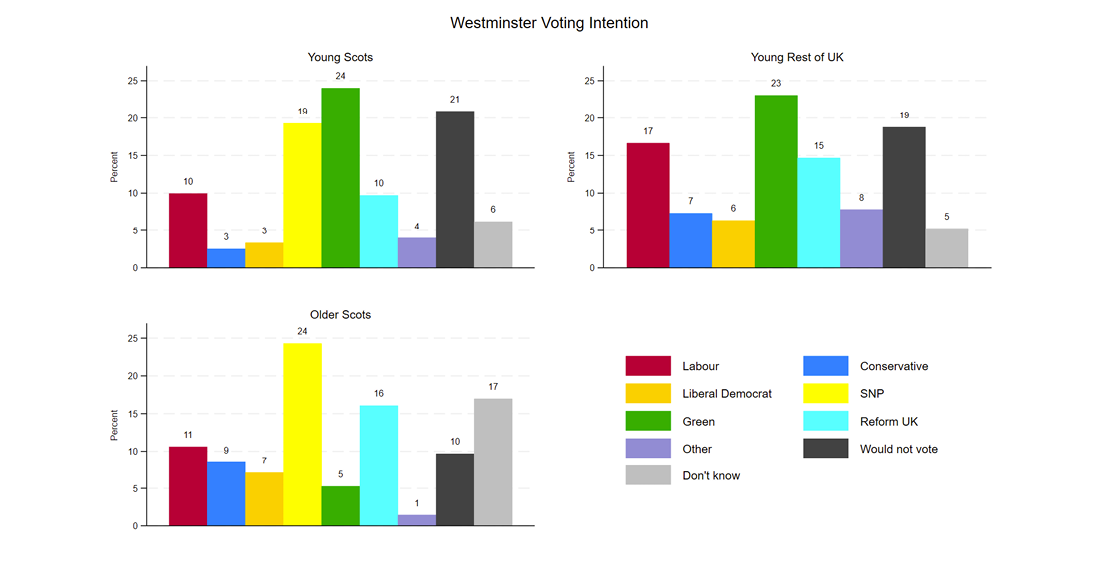
Finally, the Westminster voting intentions of young Scottish people are distinct from those of their counterparts in the rest of the UK and their older compatriots, but in different ways. Figure 3 shows that 19% of young Scottish people would vote for the SNP in a UK general election but, of course, this option is not available to young people elsewhere in the UK who instead have higher percentages who would vote Labour, Conservative, Liberal Democrat, and Reform. These higher percentages intending to vote for other parties in the rest of the UK add up to exactly 19% more than the percentages who would vote for those parties in Scotland, which is the same as the percentage intending to vote SNP. The percentages who would vote Green and who would not vote are very similar in both geographies.
Though they share electoral options with their older compatriots, young Scottish people are much more likely to intend to vote Green or not vote. They are less likely to intend to vote Reform, SNP, Conservative and Liberal Democrat, and equally likely choose Labour. Piecing this all together, we see a young electorate in Scotland who reflect their self-perceived left-wing ideological position in the parties they intend to vote for. 53% of young Scots intend to vote for a party of the left or centre-left (SNP, Green or Labour), whilst 13% intend to vote for a party of the right (Conservative or Reform). The figures for young people in the rest of the UK, and for older Scots, are 40% leaning left and 24% leaning right. This is a remarkable finding: older Scots intend to vote left and right in exactly the same proportions as young people in the rest of the UK, and this distinguishes both groups from more left-leaning young Scottish people. See Figure 3.
The generation of young Scottish people who came of political age around and after the 2014 Scottish independence referendum are distinctively left-wing. This is true in terms of how they see themselves ideologically and how they would vote if there were a Westminster general election tomorrow. They prioritise bread and butter issues in a similar manner to older Scots and, especially, young people in the rest of the UK, but it remains to be seen whether their positions on these issues are also more left-wing.
1 The focus of the Scottish Election Study (SES) question is on the most important issue facing Scotland, whilst the UK Youth Poll (UKYP) asks about the most important issue facing the UK. The list of options also differs slightly across the two surveys, whilst the SES asks about the three most important issues as opposed to the five asked about in the UKYP. Finally, the “Inflation and the cost of living” and “Jobs and job security” issues in the UKYP were combined to create the equivalent to the “economy” issue in the SES. The data, then, have some key differences but are still broadly comparable.
