
Dr Emilia Belknap
Research Fellow in Politics and International Relations, University of Southampton.
Her research sits within comparative political behaviour and institutions, with a particular focus on how identity, public opinion, and institutional structures shape democratic legitimacy and political outcomes.

Scottish Election 2026
Section 3: Voters, polls and the electoral system
- Elections and voting as rituals: Comparing Scotland with Australia (Prof Ariadne Vromen)
- The electoral system: The most disproportional result yet (Prof Sir John Curtice)
- The system is working (as intended): What Scottish voters actually wanted on 7 May 2026 (Prof Christopher Carman, Prof Ailsa Henderson)
- The Meh election? Campaign dynamics in the 2026 Scottish Parliament election (Prof Christopher Carman, Prof Robert Johns)
- MRPs: a false dawn (Dr Eoghan Kelly)
- Changing electoral battlegrounds: The rise and fall of extreme two-party contests (Prof Ailsa Henderson)
- Distinctively left-wing? Comparing young Scottish people to the rest of the UK and older Scots (Dr Joe Greenwood-Hau)
- Scotland: A country of aging disruptors? (Dr Jan Eichhorn)
- Shifting tides: Gender, independence and constitutional politics in the 2026 Scottish election (Dr Emilia Belknap)
- Why did Reform make a breakthrough? Evidence from the Scottish Election Study (Dr Fraser McMillan)
- Mapping Reform UK’s vote in the 2026 Scottish Parliament election (Dr Davide Vampa)
- The SNP: hegemony in a time of crisis? (Dr Sebastian Dellepiane-Avellaneda, Prof Anthony McGann)
The constitutional question continues to structure Scottish politics, but the 2026 Scottish Parliament election suggests that the meaning of independence politics may be changing. The campaign unfolded in a markedly more fragmented political environment than the referendum era, shaped by voter volatility, weakened party loyalties and political trust, and growing concerns over public services and economic insecurity. Final polling before election day suggested that around one-quarter of voters could still change their minds, while the election itself produced a fragmented parliament in which the SNP remained dominant but fell short of a majority, Reform UK tied Labour for second place, and the Greens secured their first constituency victories.
These shifts matter not only for party competition, but also for how we understand constitutional voting behaviour itself. For much of the devolution era, analyses of constitutional attitudes focused on a persistent “gender gap” in support for Scottish independence: men tended to express stronger support for constitutional change, while women appeared more sceptical. Yet longitudinal survey evidence suggests a more complicated pattern. Women have not simply been less supportive of independence; they have also been more likely to occupy an undecided or politically conditional position on Scotland’s constitutional future.
The idea that women are less supportive of Scottish independence has long occupied an important place in scholarship on Scottish politics. Across multiple Scottish Social Attitudes (SSA) surveys between 1999 and 2019, men were consistently more likely to express support for greater constitutional autonomy or independence, while women were more likely to oppose it. This pattern also appeared in the Scottish Election Study (SES) data. These findings contributed to wider interpretations of the constitutional divide as gendered, often linked to differing perceptions of economic risk, constitutional uncertainty, or campaign tone.
However, focusing solely on support versus opposition obscures another striking longitudinal pattern: women were also consistently the most undecided group across major survey datasets. During the 2014 referendum campaign, women were significantly more likely than men to report being undecided, and later SES data similarly showed women were more likely to express uncertainty or disengagement from constitutional positioning. Taken together, these findings suggest that the constitutional gender gap has historically been characterised less by stable female opposition to independence than by differing levels of political certainty and constitutional attachment.
This distinction matters in 2026 because constitutional politics no longer operates within the same political environment that defined the referendum era. Scholars describe the post-2014 period in Scotland as one of “symbiotic polarization”, in which the SNP and Conservatives mutually reinforced constitutional conflict and stabilised politics around increasingly entrenched “Yes” and “No” identities.
Yet after 2022, this political equilibrium began to weaken. The prospect of a second referendum receded, constitutional fatigue increased, and political competition expanded beyond independence alone. Under Nicola Sturgeon, independence had increasingly been connected to wider themes of welfare, public services, inclusion, and European identity, broadening its appeal beyond constitutional nationalism itself. However, internal SNP instability, controversies surrounding Gender Recognition Reform, and growing dissatisfaction with governance and public services shifted political attention towards competence, institutional trust, and political management. For voters whose constitutional preferences were already more conditional or uncertain — including many women voters identified in earlier survey research — these wider political evaluations may now matter more than constitutional identity alone.
Recent survey evidence hints at this transformation. While earlier SSA datasets consistently identified men as the strongest supporters of independence and women as the most opposed, more recent waves complicate this picture. In the 2021–22 and 2023 SSA surveys, women appeared marginally more supportive of independence than men. Women remained disproportionately represented among undecided respondents, suggesting that ambivalence remains important even as outright opposition declines.
Newer research also suggests the referendum-era gender gap was never simply a matter of women being inherently more “risk-averse” than men. Research on the 2014 referendum found that both Yes Scotland and Better Together campaigns targeted voters through highly gendered narratives around care, family responsibility, and economic security, often portraying women as cautious household decision-makers while men were more closely associated with nationalism and political agency.
The 2026 election cannot itself tell us whether the constitutional gender gap has disappeared. However, it may indicate changing relationships between gender, party support, and constitutional politics. Lower turnout, rising fragmentation, and growing concern over governance and public services suggest that constitutional identity may no longer anchor political behaviour as consistently as it once did. This matters because women were historically more likely to occupy conditional or undecided constitutional positions. The challenge for pro-independence parties may therefore no longer simply be mobilising constitutional identity, but persuading voters that constitutional change offers credible answers to questions of governance, security, public services, and political trust.
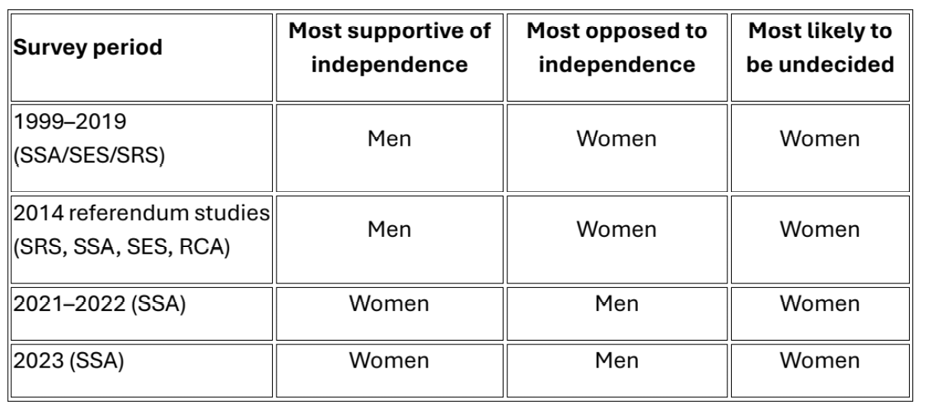
Source: Author analysis of Scottish Social Attitudes Survey (SSA), Scottish Election Study (SES), Scottish Referendum Study (SRS), and the Risk and Constitutional Attitudes (RCA) Survey, 1999–2023.
