Dr Eoghan Kelly
Postdoctoral Researcher leading the Mile End Institute’s, Queen Mary University of London’s Polling London Project. He has lectured on quantitative methods at Queen’s University, Belfast and worked on the Scottish Election Study. He is the co-founder of DevolvedElections.co.uk which creates customisable projections of the Scottish Parliament.
Scottish Election 2026
Section 3: Voters, polls and the electoral system
- Elections and voting as rituals: Comparing Scotland with Australia (Prof Ariadne Vromen)
- The electoral system: The most disproportional result yet (Prof Sir John Curtice)
- The system is working (as intended): What Scottish voters actually wanted on 7 May 2026 (Prof Christopher Carman, Prof Ailsa Henderson)
- The Meh election? Campaign dynamics in the 2026 Scottish Parliament election (Prof Christopher Carman, Prof Robert Johns)
- MRPs: a false dawn (Dr Eoghan Kelly)
- Changing electoral battlegrounds: The rise and fall of extreme two-party contests (Prof Ailsa Henderson)
- Distinctively left-wing? Comparing young Scottish people to the rest of the UK and older Scots (Dr Joe Greenwood-Hau)
- Scotland: A country of aging disruptors? (Dr Jan Eichhorn)
- Shifting tides: Gender, independence and constitutional politics in the 2026 Scottish election (Dr Emilia Belknap)
- Why did Reform make a breakthrough? Evidence from the Scottish Election Study (Dr Fraser McMillan)
- Mapping Reform UK’s vote in the 2026 Scottish Parliament election (Dr Davide Vampa)
- The SNP: hegemony in a time of crisis? (Dr Sebastian Dellepiane-Avellaneda, Prof Anthony McGann)
This is the first Holyrood election to see Multi-level Regression and Post Stratification (MRPs) become a major part of the polling landscape. MRPs differ from traditional polls by having much larger sample sizes which are used to build constituency and regional level projections. The exact details differ from company to company, but generally they use underlying demographics to estimate constituency level vote shares.
At their best, MRPs provide a level of information which exceeds any combination of traditional polling and seat projections; at worst they spin a tangled web of overlapping demographics which create incoherent numbers. If the demographics are poorly understood, or rely on flawed assumptions, the resulting MRPs can be considerably worse than traditional polling. If the chaotic results are taken as fact by the media this can damage public understanding of elections.
In Scotland it appears that poor quality MRPs and media acquiescence were significant aspects of the campaign. For example, Find Out Now/Electoral Calculus’s MRP recorded Strathkelvin & Bearsden as safe for the SNP, More In Common (2026) called it for the Liberal Democrats and JL Partners (2026) thought Reform were winning. More In Common were right, but simultaneously claimed that Reform would win Ayr, where they really finished fourth.
The MRPs differed in sporadic and confusing ways. A much larger problem was highlighted by JL Partners (2026) who released an MRP which incorrectly applied the D’Hondt formula which meant they announced the SNP would win 11 List seats despite having the votes for none. This went entirely unacknowledged by the media as the Telegraph (Freedland, 2026), who had funded the poll, repeated these incorrect numbers. The Telegraph also featured JL Partners’ Welsh MRP (Diver, 2026) despite it only declaring winners for 82 of the 96 Senedd seats, and misapplying D’Hondt on the seats it did call. Two Stonehaven MRPs in February and April were labelled “Mega Polls” despite relying on recent sample sizes of under 500 respondents (Stonehaven, 2026). These 500 respondents were stitched on top of larger samples spread across several months.
There was an additional complication this year as the Greens were polling at around 8% of the constituency ballot before confirming that they would only contest 6 constituency seats. It meant that in 67 seats the Greens’ share would be exactly 0% because they were not fielding candidates, yet JL Partners (2026) and FindOutNow/Electoral Calculus (2026) projected vote shares for them anyway. FindOutNow/Electoral Calculus, for instance, projected the Greens would come away with 9% of the Constituency Vote. In both cases, any reallocation of the Green share would have flipped some marginal seats to the SNP. Despite these eyebrow raising claims, there appears to have been widespread unwillingness to question MRPs despite such poor practices and basic mathematical mistakes.
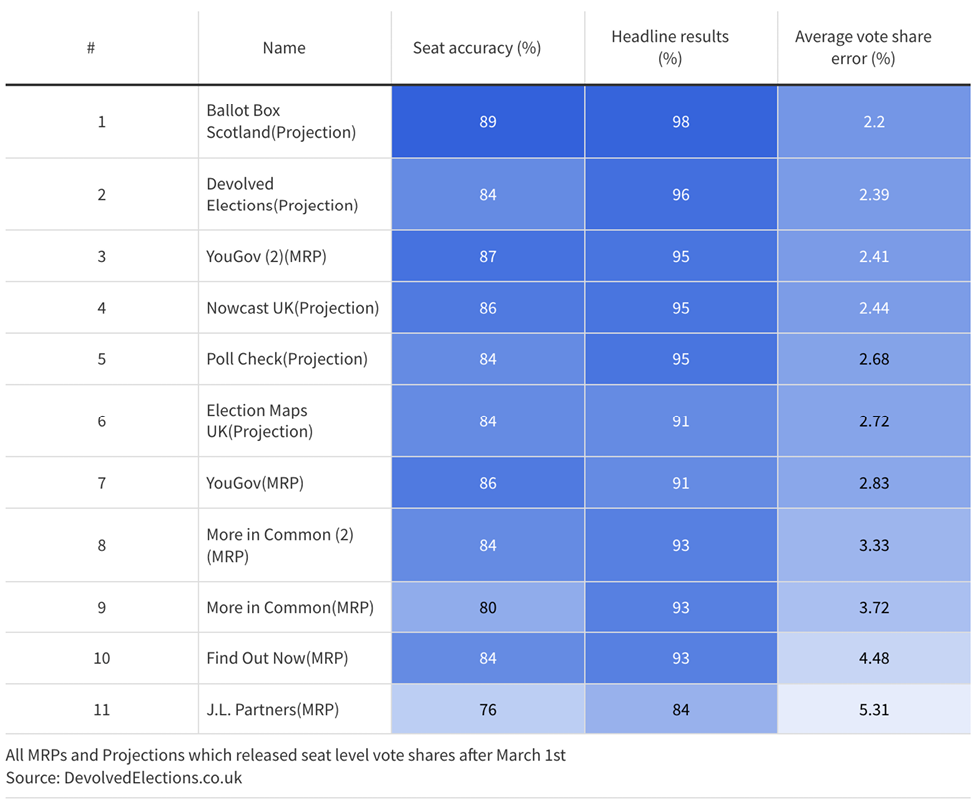
When compared to the actual results, MRPs do not tend to fare well. Table 1 displays the results from the various MRPs and seat projections. YouGov’s final poll was good and was about as accurate as many of the seat projection sites which use swing models, and by most measures they were the second or third best seat projection. However, every other MRP was no better than the least accurate projection site. Ballot Box Scotland topped every measure. See Table 1.
What is particularly concerning is that the MRPs were not off in any consistent way, rather they were erratic and contradictory. For every accurate but unusual call, Labour winning Na h-Eileanan an Iar (Stonehaven, 2026) and the Lib Dems winning Strathkelvin and Bearsden (More in Common, 2026) there were unusual but incorrect calls, Reform winning Cunninghame South (Stonehaven, 2026b), and Lib Dems winning three regional seats in North East Scotland (More in Common, 2026). It meant that it was not possible to anticipate which of these unlikely announcements were prescient and which were erroneous.
In 2024 MRPs worked in England but not in Scotland (Stonehaven, 2024). And in 2026, they again have not worked in Scotland, although they fared better in Wales (Devolved Elections, 2026). It could be that Scotland is too complex to model with MRPs, or Scotland is too different from England for English MRP pollsters to adapt to – the latter appears to be more likely. The mistake in not following the electoral rules by JL Partners is indicative of this, as were the continuing inclusion of the Greens in seats they were not contesting.
The headline vote shares released by polls using a more standard methodology and approach were generally accurate, but as the average MRP costs considerably more than a traditional poll it meant that more of an already limited polling budget was spent on generating inaccurate local numbers. It is possible that this played a role in the drop in the total number of polls this year – there were 17 in the final month before the 2021Scottish Parliament election and 15 this year. Five of those appeared on the final day of the campaign and announced very different expected vote shares so did not provide any further clarity.
The focus on MRPs throughout the 2026 Holyrood campaign led to fewer polls, cost more money, and produced erratic claims due to some poor, or at least not transparent, methodological practices. The campaign highlights that whilst MRPs can add value, as demonstrated by the accuracy of the final YouGov poll, they remain a new and fallible source of information. The 2024 misses in Scotland should have served as a warning to the media and to the polling companies that more care was needed in estimating Scottish voting behaviour, however lessons do not yet appear to have been learned.