Prof Ailsa Henderson
Professor of Political Science at the University of Edinburgh and Principal Investigator for the Scottish Election Study 2026-2031.

Scottish Election 2026
Section 3: Voters, polls and the electoral system
- Elections and voting as rituals: Comparing Scotland with Australia (Prof Ariadne Vromen)
- The electoral system: The most disproportional result yet (Prof Sir John Curtice)
- The system is working (as intended): What Scottish voters actually wanted on 7 May 2026 (Prof Christopher Carman, Prof Ailsa Henderson)
- The Meh election? Campaign dynamics in the 2026 Scottish Parliament election (Prof Christopher Carman, Prof Robert Johns)
- MRPs: a false dawn (Dr Eoghan Kelly)
- Changing electoral battlegrounds: The rise and fall of extreme two-party contests (Prof Ailsa Henderson)
- Distinctively left-wing? Comparing young Scottish people to the rest of the UK and older Scots (Dr Joe Greenwood-Hau)
- Scotland: A country of aging disruptors? (Dr Jan Eichhorn)
- Shifting tides: Gender, independence and constitutional politics in the 2026 Scottish election (Dr Emilia Belknap)
- Why did Reform make a breakthrough? Evidence from the Scottish Election Study (Dr Fraser McMillan)
- Mapping Reform UK’s vote in the 2026 Scottish Parliament election (Dr Davide Vampa)
- The SNP: hegemony in a time of crisis? (Dr Sebastian Dellepiane-Avellaneda, Prof Anthony McGann)
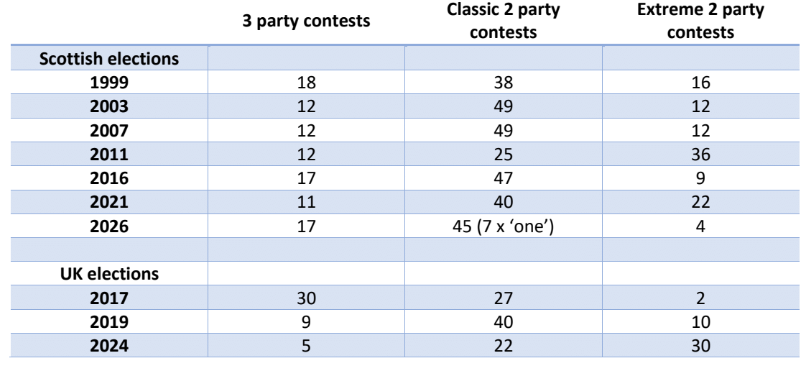
Constituency contests vary in three ways: by the size of marginality (from safe to marginal), by the parties contesting seats, and by the type of contest. Here we can distinguish between three party contests, in which three parties earn at least 20% of the vote, “classic” two-party contests in which the third placed party earns between 10 and 20%, and “extreme” two-party contests, in which the third placed party earns less than 10% of the vote.
In the UK General Elections of 2017, 2019 and 2024 Scotland slowly transformed from largely three-party contests to extreme two-party contests. At a devolved level, a similar shift occurred between 2016 and 2021, though extreme two-party contests also featured in the early years of devolution. Their origins differ. One cause is negative partisanship toward the Conservatives combined with geographically concentrated Liberal Democrat support, producing Labour–SNP duopoly contests between 1999 and 2007. Another is tactical voting, where voters with stable party preferences swing behind different parties to achieve particular ends.
Much of the 2017 to 2024 transformation in general election contests can be explained by pro-union tactical voting in which voters swung their support behind the party best placed to unseat the SNP. Such “extreme” two-party contests were effective: only one (Dundee Central) was not won from the SNP in 2024. In Holyrood contests, eight of the ten non-SNP seats in 2021 were extreme two-party contests. This shift coincides with the increase of tactical voting to 20% in 2021, 83% of which was anti-SNP. Together, these patterns show pro-union voters growing more efficient, drawing on historic party strength to identify the strongest contender against the SNP.
The arrival of Reform in the 2026 election threatened to disrupt this in several ways, fracturing the party system, with the vote shares of the three largest parties adding to 73% rather than the 90% in the three previous elections. The average winning vote share also dropped from 49 to 42%. Reform’s arrival also disrupted pro-union tactical voting, altered the nature of constituency contests.
It was clear from 2024 that pro-union voters were not equally keen to swing their votes behind Conservative candidates: there was not a single constituency in which support for other pro-union parties dipped below 10% to give Conservatives the best chance of unseating the SNP. In 2026, the same applied of Reform. Asked by Norstat who they would back in a contest between only the SNP and Reform, two-thirds of Labour supporters and three-quarters of Liberal Democrat supporters said they would vote SNP. This suggested not just that there would be a cordon sanitaire around Reform tactical voting, but that Reform’s presence could erode the “within-block” constitutional voting that had previously held.
In 2026 there was a resurgence of classic two-party contests, with the SNP and at least one other party above 20% and others between 10 and 20%. This reflects both the pre-existing unwillingness to back Conservative candidates and a new aversion among some pro-union supporters to backing Reform.
The declining popularity of the UK Labour government also reduced Labour’s appeal as a tactical host for pro-union votes. Two dynamics were at play: genuine dissatisfaction with UK Labour filtering through to Scottish Labour, and a perception that Scottish Labour was unlikely to successfully capitalise on tactical voting and therefore was a poor investment for floating voters.
The effects of this were clear: the Liberal Democrats proved better placed than other parties to capitalise on pro-union switching, even where substantial swings were required. Labour tended to benefit only where it held a constituency incumbency. This explains why it was able to acquire Edinburgh Southern but failed to capture the more marginal East Lothian Coast and Lammermuirs from the SNP. The Hamilton, Larkhall and Stonehouse by-election, won by Labour in 2025, offered no protection to its short-term incumbent.
This election also saw four extreme contests; three were won by parties other than the SNP, confirming that extreme contests remain an efficient way to defeat the largest pro-indy party. At the other end of the spectrum, the SNP triumphed in all but one of the 17 “three-party” contests.
The election also saw the emergence of a new type of contest: seven “one-party” contests, in which only one party earned more than 20% of the vote. In six of seven cases the SNP remained dominant against a fractured pro-union vote (with no Green candidates standing in any of them). This is the predictable consequence of party system expansion: more parties produce more fragmented competition.
Across all classic contests the “best contender” against the SNP was Labour 26 (2 successful, 24 not), Conservative 11 (4 successful, 7 not), LD 7 (4 successful), Reform 1 (unsuccessful), Green 1 (successful). The resurgence of classic two-party contests was largely attributable to Reform as a specific additional party. In 29 of the classic contests, the other pro-union parties had reduced support below 10% but Reform did not, leaving the SNP and one main contender above 20% with Reform alone between 10 and 20%.
There are two possible interpretations: either tactical voting collapsed across the board, with voters naturally drifting toward parties with low local support; or — more plausibly, and consistent with preliminary SES evidence — Reform supporters prioritised party loyalty over efficient anti-SNP voting. On this reading, Reform “broke” the tactical coordination pro-union voters had built up over successive elections.