
Dr Jan Eichhorn
Senior Lecturer in Social Policy at the University of Edinburgh and a co-investigator on the Scottish Election Study. His work focusses on the political engagement and perceptions of young people, as well as economic views. He is also research director of the think tank d|part.

Scottish Election 2026
Section 3: Voters, polls and the electoral system
- Elections and voting as rituals: Comparing Scotland with Australia (Prof Ariadne Vromen)
- The electoral system: The most disproportional result yet (Prof Sir John Curtice)
- The system is working (as intended): What Scottish voters actually wanted on 7 May 2026 (Prof Christopher Carman, Prof Ailsa Henderson)
- The Meh election? Campaign dynamics in the 2026 Scottish Parliament election (Prof Christopher Carman, Prof Robert Johns)
- MRPs: a false dawn (Dr Eoghan Kelly)
- Changing electoral battlegrounds: The rise and fall of extreme two-party contests (Prof Ailsa Henderson)
- Distinctively left-wing? Comparing young Scottish people to the rest of the UK and older Scots (Dr Joe Greenwood-Hau)
- Scotland: A country of aging disruptors? (Dr Jan Eichhorn)
- Shifting tides: Gender, independence and constitutional politics in the 2026 Scottish election (Dr Emilia Belknap)
- Why did Reform make a breakthrough? Evidence from the Scottish Election Study (Dr Fraser McMillan)
- Mapping Reform UK’s vote in the 2026 Scottish Parliament election (Dr Davide Vampa)
- The SNP: hegemony in a time of crisis? (Dr Sebastian Dellepiane-Avellaneda, Prof Anthony McGann)
In political discussions young people are often presented as disruptors. Dissatisfied with the status quo they are frequently portrayed as eager for change, with a greater willingness to consider a wider variety of parties in elections, for example, and less regard for existing patterns of voting. But the recent Scottish elections paint a more complex picture. While younger voters were much more likely to vote for the Greens than older ones, the Green Party is hardly a “new kid on the block” in Scottish politics anymore. However, older voters do not simply vote for established parties in Scotland. In contrast, they were much more likely to indicate that they planned to vote for Reform UK in the 2026 Scottish Parliament elections. While there is great variation in views and preferences in all age groups, who really are the anti-status-quo disruptors in Scotland? Data from the Scottish Election Study’s survey conducted before the vote offers some insights.
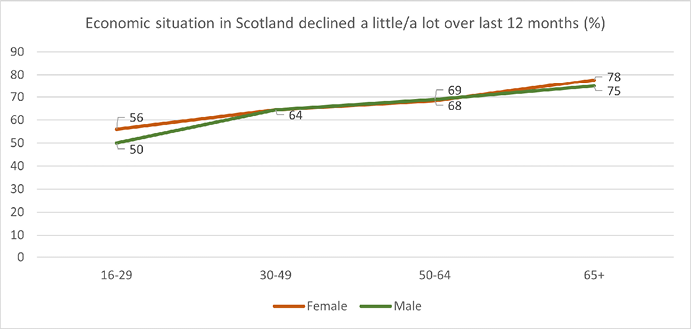
Young people in Scotland are not satisfied with the current situation. Reflecting, for example, on the economic situation ahead of the elections, a majority of both women (56%) and men (50%) aged 16 to 29 years felt that it had worsened over the past 12 months. Older voters viewed the situation as considerably worse, however. 78% of women and 75% of men aged 65 years and over felt that the economy had declined.
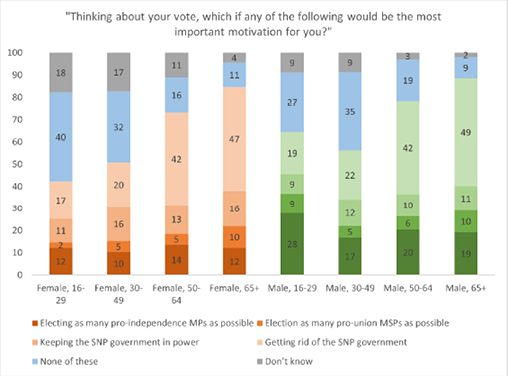
Overall, older voters’ motivations appeared to be driven much more by strategic views on who should govern Scotland, with many expressing a strong desire for change at the helm. When asked to consider strategic reasons that could be the most important motivation for their vote, nearly half of voters aged 65 years and over selected “getting rid of the SNP government”. Amongst the youngest age group (16 to 29 years) fewer than one in five said the same.
Strikingly, when presented with a range of pro- or anti-independence as well as pro- or anti-SNP government propositions as possible motivations, many young people did not find these that important at all. 40% of women and 27% of men aged 16 to 29 years identified none of these options as key to their vote choice. The same applied to only around one in ten amongst those 65 years and older.
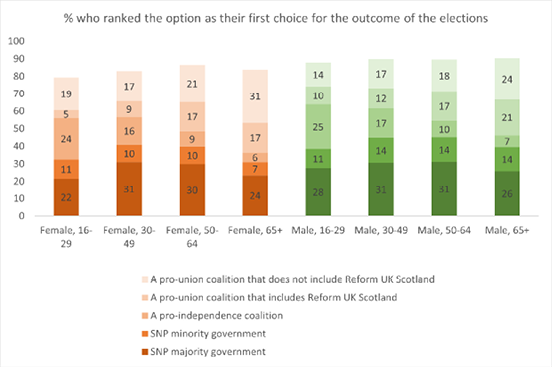
But this was not because the youngest voters felt distinctively more favourable towards a continued SNP government. Only 22% of 16- to 29-year-old women and 28% of men in that age group said their preference post-election would be a SNP majority government. This is broadly comparable to women (24%) and men (26%) in the oldest age group. Younger voters were however much more likely to prefer a pro-independence coalition (involving the Green Party) with around one in four of them in favour – compared to a meagre 6% in the oldest age group.
Voters aged 65 years and more in contrast were much more likely to favour a pro-union coalition and were much more open than young voters for such a coalition to include reform: 17% of older women and 21% of older men saw that as their preferred choice, compared to only 5% amongst younger women and 10% of younger men respectively.
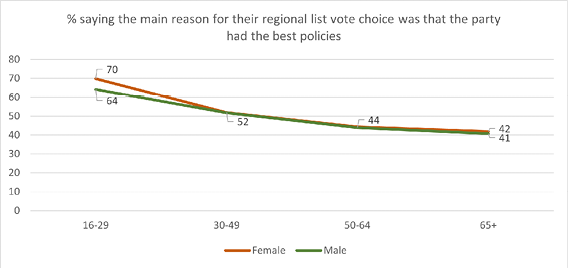
The constitutional question was thus important to young people, but not shaping their choice as much as it did for older voters – nor did it function as a strong identity marker. One in three young people says that they do not consider themselves as belonging to either the “Yes side” or “No side”, while only 16% of women and 11% of men in the oldest age group say the same. Instead, the vast majority of 16- to 29-year-old voters (70% of women and 64% of men) said that in choosing the party for the list vote, the party they intended to vote for actually had the best policies. In the oldest age group just over 40% said the same. Tactical considerations or just an expression of habit (“I always vote this way”) were more important for this group than for younger people.
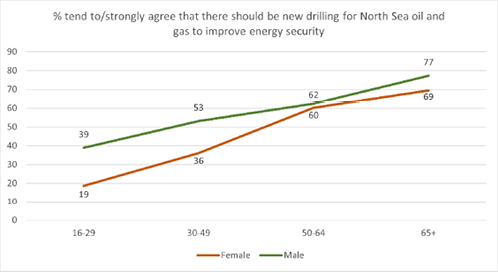
And there are some big differences in policy preferences – on average – between younger and older voters. Take for example the contentious question of whether there should be new drilling for oil and gas in the North Sea to improve energy security. There are proponents and opponents in all age groups, but the proportions are dramatically different: Amongst those 65 years and older, 77% of men and 69% of women supported that proposition. In the group of 16- to 29-year-olds support was much lower with 39% of men and a mere 19% of women agreeing.
What does this look at age differences reveal? There is a diversity of views in each demographic group, but we see some big average age differences in political outlook in Scotland. These are not simply differences in party support or explained by constitutional issues. Those play a role, but importantly, many young people seem to be driven in their vote choices by policy concerns, while older people are much more likely to identify tactical reasons – and often an opposition to the incumbent SNP government. Neither younger nor older voters are happy about the status quo. But the lenses through which they consider change seem to differ quite a lot.
_
Note: All data presented is from the Scottish Election Study’s pre-election wave of data collection. Data is unweighted.
