Dr Fraser McMillan
Lecturer in Scottish Electoral Politics at the University of Edinburgh and a co-investigator on the 2026 Scottish Election Study. In addition to devolved voting behaviour, his main research interests are party competition and the role of election pledges in representative democracy.

Scottish Election 2026
Section 3: Voters, polls and the electoral system
- Elections and voting as rituals: Comparing Scotland with Australia (Prof Ariadne Vromen)
- The electoral system: The most disproportional result yet (Prof Sir John Curtice)
- The system is working (as intended): What Scottish voters actually wanted on 7 May 2026 (Prof Christopher Carman, Prof Ailsa Henderson)
- The Meh election? Campaign dynamics in the 2026 Scottish Parliament election (Prof Christopher Carman, Prof Robert Johns)
- MRPs: a false dawn (Dr Eoghan Kelly)
- Changing electoral battlegrounds: The rise and fall of extreme two-party contests (Prof Ailsa Henderson)
- Distinctively left-wing? Comparing young Scottish people to the rest of the UK and older Scots (Dr Joe Greenwood-Hau)
- Scotland: A country of aging disruptors? (Dr Jan Eichhorn)
- Shifting tides: Gender, independence and constitutional politics in the 2026 Scottish election (Dr Emilia Belknap)
- Why did Reform make a breakthrough? Evidence from the Scottish Election Study (Dr Fraser McMillan)
- Mapping Reform UK’s vote in the 2026 Scottish Parliament election (Dr Davide Vampa)
- The SNP: hegemony in a time of crisis? (Dr Sebastian Dellepiane-Avellaneda, Prof Anthony McGann)
The 2026 election marked a watershed moment for the Scottish Parliament as a populist radical right party won seats at a Holyrood election for the first time. From essentially a standing start, Reform UK Scotland came joint second place with 17 seats, all obtained from a 16.6% vote share on the regional list portion of the ballot (about a percentage point more than they achieved across the country’s 73 single member constituencies). They cannibalised the Scottish Conservatives’ base of support, relegating that party from second to fifth position overall.
Indeed, early, unweighted Scottish Election Study data, shown in Table 1, suggests that more than half of Reform list votes came as direct transfers from the Conservatives. The party were also able to attract some previous non-voters as well as some direct switchers from the SNP and Labour, although these represent a small overall share of the electorate. Nonetheless, it suggests they were able to pull in voters from across the constitutional and left-right divides in a way the Scottish Conservatives never could.
Despite speculation about the possibility of a hidden “shy” Reform vote in the closing stages of the campaign, the party finished at the lower end of what the opinion polling suggested they would achieve, and this perhaps explains Scottish leader Malcolm Offord’s rather muted BBC Scotland interview on the day of the count. The idea that Reform could surge to 20 or more seats by mobilising low-propensity, “scunnered” voters did not pan out.
Nonetheless, the result is an impressive one for a completely new challenger, and Reform will disrupt the dynamic at the Scottish Parliament with a brand of populist right opposition the Scottish National Party government has not encountered before. Scotland was once an outlier in European politics, with populist right parties attracting a remarkably small share of the vote – that has now changed.
And we have some reason to think that the core base of support Reform mobilised at this election is very “sticky”. Their supporters were by far the least likely to split their vote across the constituency and list ballots. According to SES data, 75% of those who voted Reform on either ballot did so on both ballots, compared to 62% for the Conservatives, the party with the next highest retention across constituency and list. Reform supporters are mostly dissatisfied with all the other parties and were therefore disinterested in playing tactical games at the ballot box.
But the party is not simply a repository for protest votes. Reform UK voters have a very distinct attitudinal profile in the Scottish electorate and, unlike residual Scottish Conservative supporters, are not uniformly anti-independence. That said, nearly half of Reform voters’ constitutional preference is not just to remain in the union but to abolish the Scottish Parliament altogether. In the SES pre-election survey, when asked to place themselves on a scale where 0 means “Abolish the Scottish Parliament” and 10 means “Independence for Scotland”, 46% of Reform voters selected 0. This compares to just 15% across the entire sample.
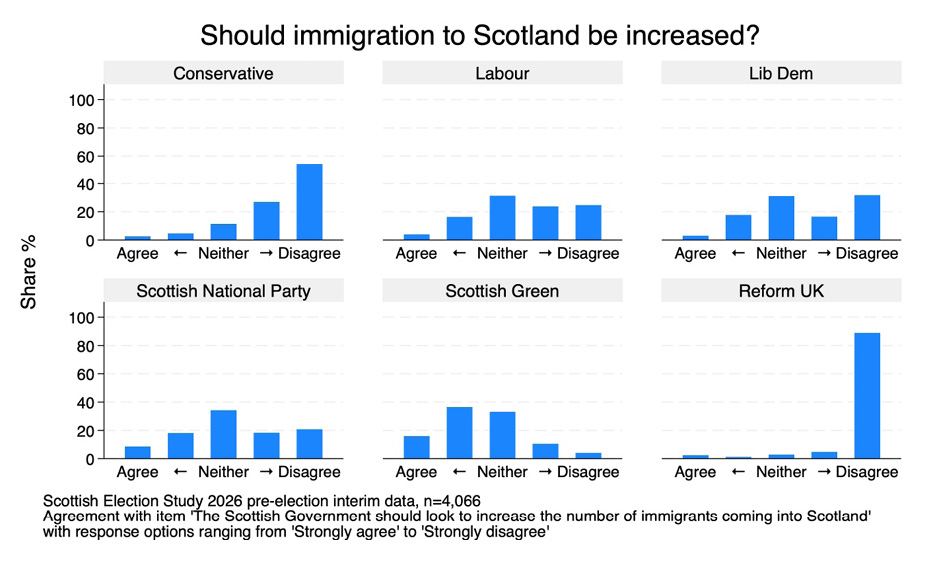
Not surprisingly, Reform supporters stand out most clearly in their attitudes to immigration. Figure 1 shows agreement with the statement that “The Scottish Government should look to increase the number of immigrants coming into Scotland”, broken down by respondents’ list vote. It is worth bearing in mind that the Scottish Parliament has very limited powers over immigration, so this question is more one designed to get at overall policy attitudes rather than specific actions a devolved administration could take. Reform supporters near-uniformly “Strongly disagree” with this item. And while Scottish Conservative supporters are also opposed to increased immigration, their attitudes are not as strongly held on average.
This striking visualisation neatly demonstrates the highly distinct policy preferences of Reform supporters versus those of other parties. It suggests that the reason for their support is not that there was never any electoral demand for a party with this policy profile, but a lack of supply in the party system. In other words, it seems from these data that Reform UK have filled a yawning gap in Scotland’s electoral market.
That said, Reform’s success north of the border is unlikely to translate into direct policy influence, particularly given John Swinney’s pointed refusal to invite the party for talks at the First Minister’s official residence ahead of his inevitable re-election to that role. For now, Reform are politically radioactive at Holyrood and are unlikely to find much space to collaborate with other parties.
However, this probably suits them for now. With a core base of support established and a strong foothold in parliament, Reform can continue to loudly oppose the SNP and other established parties. Scotland’s radical right breakthrough has finally arrived, and it’s not going away quietly.
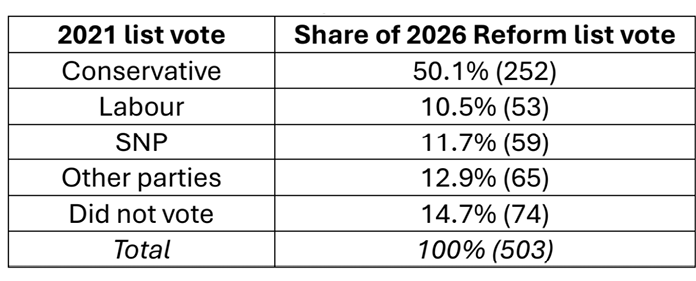
Source: Scottish Election Study pre-election survey interim data, combined vote intention and postal vote choice