
Dr Davide Vampa
Senior Lecturer in Territorial Politics and Co-Director of the Centre on Constitutional Change at the University of Edinburgh. He is also Lead Editor of Regional & Federal Studies. His research examines territorial politics, public policy, democratic representation, electoral change, and inequalities within European multi-level governance systems.

Scottish Election 2026
Section 3: Voters, polls and the electoral system
- Elections and voting as rituals: Comparing Scotland with Australia (Prof Ariadne Vromen)
- The electoral system: The most disproportional result yet (Prof Sir John Curtice)
- The system is working (as intended): What Scottish voters actually wanted on 7 May 2026 (Prof Christopher Carman, Prof Ailsa Henderson)
- The Meh election? Campaign dynamics in the 2026 Scottish Parliament election (Prof Christopher Carman, Prof Robert Johns)
- MRPs: a false dawn (Dr Eoghan Kelly)
- Changing electoral battlegrounds: The rise and fall of extreme two-party contests (Prof Ailsa Henderson)
- Distinctively left-wing? Comparing young Scottish people to the rest of the UK and older Scots (Dr Joe Greenwood-Hau)
- Scotland: A country of aging disruptors? (Dr Jan Eichhorn)
- Shifting tides: Gender, independence and constitutional politics in the 2026 Scottish election (Dr Emilia Belknap)
- Why did Reform make a breakthrough? Evidence from the Scottish Election Study (Dr Fraser McMillan)
- Mapping Reform UK’s vote in the 2026 Scottish Parliament election (Dr Davide Vampa)
- The SNP: hegemony in a time of crisis? (Dr Sebastian Dellepiane-Avellaneda, Prof Anthony McGann)
This analysis examines constituency-level patterns in support for Reform UK, compared with the other main parties. It focuses on three constituency characteristics: deprivation, urban–rural classification, and centre–periphery location. The aim is to identify broad territorial patterns in party performance, rather than to draw firm conclusions about individual voters.
The figures discussed here are average vote shares across constituencies within each category.1 In other words, they show the average party result in, for example, more deprived constituencies compared with less deprived constituencies. This approach is useful for mapping the territorial profile of party support, but it should be complemented with individual-level data before drawing firm conclusions about voter motivations or social characteristics. The parties considered, beyond Reform, are Labour, Conservatives and Liberal Democrats. The SNP and Scottish Greens are presented together because the Greens only stood in six constituencies, and because the constituency-vote electorates of the two parties tend to overlap.
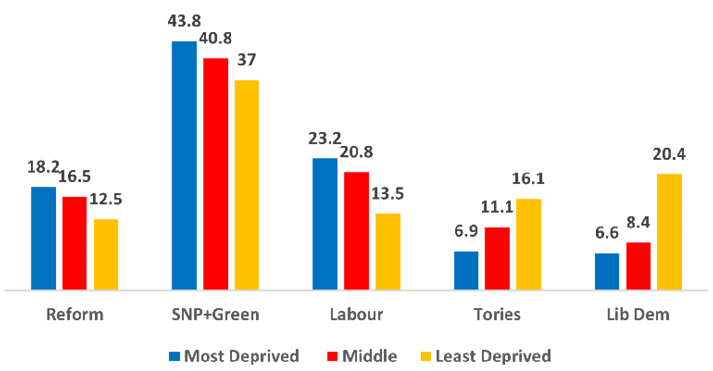
A first pattern concerns deprivation (Fig. 1). For this analysis constituencies are divided into three groups by deprivation level. Reform UK support appears to be higher in the most deprived third of constituencies than in the least deprived third. On this dimension, Reform looks closer to the SNP-Green and Labour pattern than to the Conservatives and Liberal Democrats, whose support is more concentrated in less deprived constituencies. This does not mean that Reform voters themselves are necessarily more deprived at the individual level, as constituency-level data cannot show whether voters are themselves experiencing deprivation, nor can it reveal their motivations. However, the aggregate pattern is still important. It suggests that Reform is performing relatively better in places where socio-economic pressures are more visible, and where dissatisfaction with existing political options may be more pronounced.
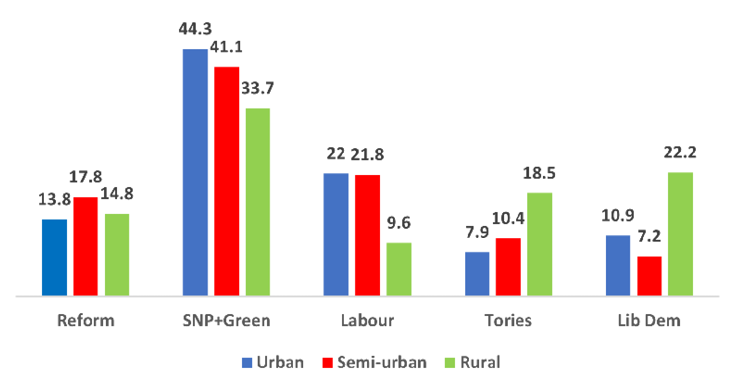
The urban–rural pattern points to a distinctive Reform geography (Fig. 2). Reform appears to perform best in semi-urban constituencies, rather than in the most urban or most rural areas. This separates Reform from the Conservatives and Liberal Democrats, who perform more strongly in rural constituencies. It is also different from the SNP-Green vote, which is strongest in urban constituencies. Semi-urban constituencies may be politically important because they often combine proximity to major urban centres with real or perceived forms of socio-economic and cultural distance from them. They may therefore provide fertile ground for parties appealing to voters in places that are close to urban centres, but do not necessarily share fully in their economic opportunities, public investment, or cultural politics.
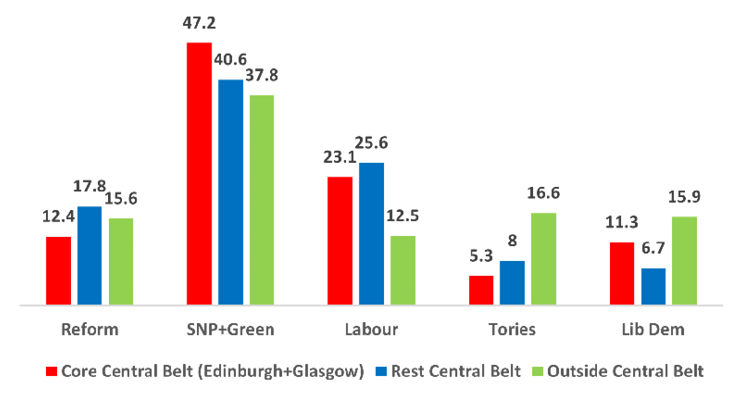
The centre–periphery divide adds a further layer to this picture (Fig. 3). Reform performs better immediately outside the Edinburgh–Glasgow political core than within it. This pattern is again distinctive. The SNP-Green vote is more clearly concentrated in the core Central Belt, while the Conservatives are stronger in more peripheral constituencies. The Liberal Democrats display a U-shaped profile across the centre–periphery divide, performing relatively well both in core and more peripheral areas. Reform’s profile is different: it is generally stronger in the periphery of the Central Belt than in the periphery of Scotland as a whole. In this sense, Reform’s geography is not simply one of rural or peripheral conservatism, but one of places within the Central Belt but outside its core: close to where political power is concentrated, but not fully part of it.
The contrast with the Conservatives is one of the most important findings. Reform UK’s pattern of support looks quite different from the Conservative map. While there may be overlap between the two electorates, Reform does not simply reproduce the traditional Conservative geography. This matters because it challenges the idea that Reform’s support in Scotland can be understood simply as a Conservative splinter or replacement vote. Its territorial profile points to a potentially broader appeal, particularly in more deprived and semi-urban constituencies.
Overall, the results suggest that Scottish party competition is structured not only by ideology or national identity, but also by clear socio-economic and territorial divides. The SNP-Green and Labour vote is more urban and central, with some strength in deprived constituencies. The Conservative and Liberal Democrat vote is more rural, peripheral, and less deprived. Reform UK occupies a distinctive position: more deprived than the Conservative map, more semi-urban than rural, and stronger outside the core Central Belt without simply replicating the geography of established unionist parties.
These findings remain preliminary. Further work using individual-level survey data, voter-weighted checks, and additional local demographic indicators will be needed to test these interpretations. Still, the constituency-level evidence suggests that any serious analysis of Reform UK’s performance in Scotland needs to take territorial divides seriously.
1 Constituency classifications: Deprivation is based on population-weighted aggregations of Scottish Index of Multiple Deprivation (SIMD) data zone scores at constituency level.
2. Urban–Rural is based on the SIMD classification of data zones, assigning each constituency to the category that represents the largest share of its zones: Urban (Large Urban Areas), Semi-urban (Other Urban Areas, Accessible Small Towns), and Rural (Remote Small Towns, Accessible Rural, Remote Rural).
3. Centre–Periphery distinguishes between Core Central Belt (Edinburgh and Glasgow), Central Belt (constituencies in the rest of the Central Belt), and Periphery (areas outside the Central Belt).
A version of this article has been published in The Conversation under a Creative Commons Attribution-No Derivatives licence [here].
