Dr Sebastian Dellepiane-Avellaneda
Senior Lecturer in Political Economy and Public Policy at the University of Strathclyde. His research interests include the politics of austerity, fiscal and monetary policy, and public opinion and policy representation.

Prof Anthony McGann
Professor of Government and Public Policy at the University of Strathclyde. His research interests include democratic theory, electoral systems and political economy. He is author of The Logic of Democracy and Gerrymandering in America.

Scottish Election 2026
Section 3: Voters, polls and the electoral system
- Elections and voting as rituals: Comparing Scotland with Australia (Prof Ariadne Vromen)
- The electoral system: The most disproportional result yet (Prof Sir John Curtice)
- The system is working (as intended): What Scottish voters actually wanted on 7 May 2026 (Prof Christopher Carman, Prof Ailsa Henderson)
- The Meh election? Campaign dynamics in the 2026 Scottish Parliament election (Prof Christopher Carman, Prof Robert Johns)
- MRPs: a false dawn (Dr Eoghan Kelly)
- Changing electoral battlegrounds: The rise and fall of extreme two-party contests (Prof Ailsa Henderson)
- Distinctively left-wing? Comparing young Scottish people to the rest of the UK and older Scots (Dr Joe Greenwood-Hau)
- Scotland: A country of aging disruptors? (Dr Jan Eichhorn)
- Shifting tides: Gender, independence and constitutional politics in the 2026 Scottish election (Dr Emilia Belknap)
- Why did Reform make a breakthrough? Evidence from the Scottish Election Study (Dr Fraser McMillan)
- Mapping Reform UK’s vote in the 2026 Scottish Parliament election (Dr Davide Vampa)
- The SNP: hegemony in a time of crisis? (Dr Sebastian Dellepiane-Avellaneda, Prof Anthony McGann)
An obvious question following the 2026 Scottish Parliament election is how the SNP has proven to be so successful for so long? It is now forming its fifth consecutive government, with a near majority of seats in Holyrood. The total seats of pro-independence parties are the highest ever, driven by significant gains made by the Greens. This is exceptional given a strong anti-incumbent mood in many other countries across the world.
When we look at the vote proportion, as opposed to seats, things are more nuanced. The SNP lost around 11% of vote share, which is more what you might expect of a party with a long run in government and recent internal conflicts. The total vote share for the pro-independence parties was actually 42%, below the 50% of the population who regularly say they would support independence.
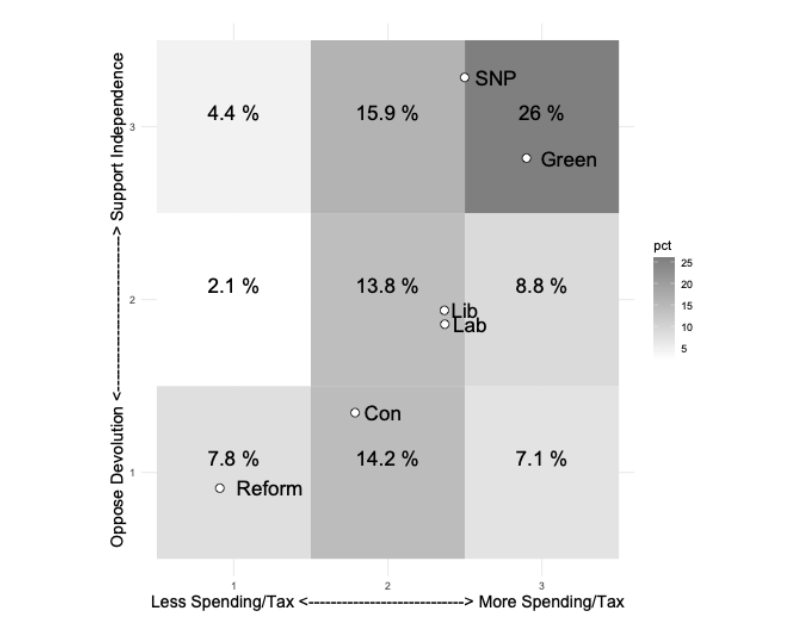
Two factors explain why the SNP has weathered the anti-incumbent surge so well: the existence of a cohesive bloc of voters who are strongly pro-independence and relatively left-wing; and the Scottish electoral system, which rewards this. Consider Figure 1: this divides the population in terms of their preferences on economic issues (10-point scale – do you want higher spending and more taxes, or the reverse), and independence (10-point scale – abolish Scottish Parliament to full independence). Data is from the 2024 Scottish Election Study (SES), and recoded into a three-point scale for display.
It has been widely reported that independence is not ranked by many voters as their most important issue, and the cost of living is mentioned most often by a considerable margin. However, even if independence is not the first concern of voters, it still structures party competition. There are essentially three electoral markets. The SNP are dominant amongst pro-independence voters (around 80% in Scottish election voting preferences in the 2024 SES) with the Greens as the main competition. Unsurprisingly, hardly any strong unionists vote SNP. This means that there is only a fairly small pool of voters with mixed (or weak) feelings on independence to whom all parties can appeal.
The SNP and Greens have a considerable advantage in that left-wing pro-independence segment of the figure is the densest, covering around 26% of the population. It is comparatively easy to put together a cohesive message to appeal to these voters and garner a large number of votes. If we were to consider other issues, such as Brexit or social issues, it would reinforce this pattern. Other parties need to appeal to voters who are more spread out ideologically. Scottish Labour faces a particular dilemma. It wants to appeal to left-wing voters, but many of these are also pro-independence. Putting together an anti-SNP coalition means covering a larger ideological space.
When we coded the parties’ manifestos, we see the consequences of this. The SNP and the Greens are far more ideological than the other parties (with the exception of Reform). In the case of the SNP there are many pro-independence statements, and a smaller number that are explicitly left-wing. In the case of the Greens, these proportions are reversed. Labour is particularly notable in being non-ideological, focussing on competence issues and attacking the SNP. It is as if the SNP and the Greens know who their voters are, and what to say to them, while the other parties are hedging their bets, trying to appeal to everyone.
Of course, the electoral system amplifies this advantage. The number of list seats is insufficient to compensate for the large party advantage in the constituency seats. The SNP was the only pro-independence party running in most constituencies, while the non-nationalist vote was more fragmented than ever. This meant it was not necessary to win a majority of the vote to win a dominant electoral majority.
Since the 2008 economic crisis, many countries have been locked in a Gramscian representation crisis. Discontented voters have abandoned traditional allegiances, resulting in anti-incumbent sentiment, frequent government changes and the collapse of party systems. In Scotland, however, the process of party system change was already well underway before 2008. The Scottish Conservative collapse in 1997 led to the SNP becoming the main opposition throughout Scotland, and the 2014 independence referendum consolidated its dominant position in the new political environment.
Over time, the cause of independence has created a focal point around which a compact progressive coalition has been able to crystalise and served as a channel for other demands for change. The narrative of progressive independence was also underpinned by the significant leftward shift in the Scottish policy mood observed over the austerity decade. The legacy of the anti-austerity mood played out in the 2026 election. The SNP and the Greens were more assertive than unionist parties in narrating the cost-of-living crisis. The SNP strategy was to narrate cost-of-living along strong territorial lines in light of the relationship with Westminster. While the Greens found a unique opportunity to recalibrate their discourse towards economic and social justice. All that said, hegemonic projects are always in dispute. There are potential tensions within the pro-independence coalition, and also within the SNP itself. Navigating these coalitional dilemmas will be a continuing challenge for the new government.